DHI Hair Transplant in Bangkok: Complete Guide
A DHI hair transplant in Bangkok uses the Choi Implanter Pen to extract and implant hair follicles in a single step - no pre-made channels, no scalpel incisions, and no linear scars. Direct Hair Implantation (DHI) has become the technique of choice for patients who want denser packing, faster healing, and the option to skip shaving entirely.
The ABHRS directory lists more than one diplomate in Bangkok, among them Dr. Jirayu Jatechayanon of Bangkok Hair Clinic, which offers DHI (read 27 September 2026). Only CosmoPrime lists a DHI rate, $1.81 to $2.72 (฿60-90) per graft, in a general price table on its own site, and HairTran and Hairsmith include the pen at their FUE price. Whether you're restoring a receding hairline or adding density to thinning areas, this guide covers everything you need to know about getting a hair transplant in Bangkok using the DHI technique.
How DHI Works: The Choi Implanter Pen Technique
DHI stands for Direct Hair Implantation. The key difference from other transplant methods is the tool: a hollow, pen-shaped device called the Choi Implanter Pen.
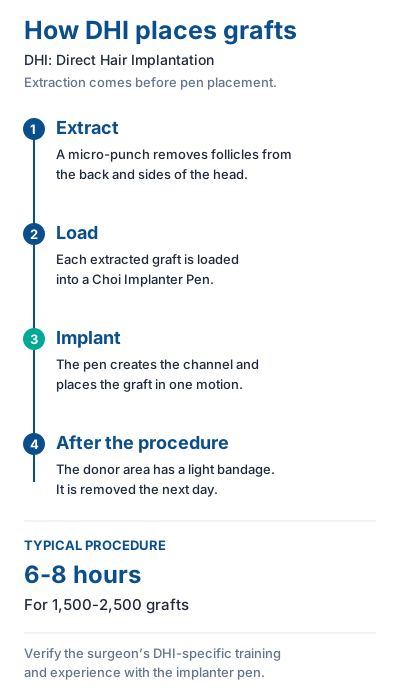
Here's the step-by-step process:
Step 1: Extraction
Individual hair follicles are extracted from the donor area (back and sides of the head) using a micro-punch tool, exactly like standard FUE. Each graft contains 1-4 hairs.
Step 2: Loading
Each extracted graft is immediately loaded into a Choi Implanter Pen. The pen has a hollow needle (0.6-1.0mm diameter) with a spring-loaded plunger mechanism. Surgical teams typically rotate between 6-8 pens to keep the process moving.
Step 3: Direct Implantation
The surgeon inserts the loaded pen into the recipient area at a precise angle (40-45°) and depth. Pressing the plunger simultaneously creates the channel and places the graft in one motion. This eliminates the separate channel-creation step required in traditional FUE.
Step 4: Post-Procedure
No stitches or bandages on the recipient area. The donor area gets a light bandage removed the next day. Total procedure time runs 6-8 hours for 1,500-2,500 grafts.
Why this matters: grafts spend less time outside the body and are handled less. In Limmer's study of grafts held in chilled saline, summarized in a review in the Journal of Cutaneous and Aesthetic Surgery (read 27 September 2026), survival was 95% at 2 hours outside the body, 90% at 4 hours, 86% at 6 hours and 88% at 8 hours. A shorter wait plausibly helps, though that data measures storage time, not technique.
DHI vs FUE: Which Technique Is Right for You?
Both DHI and FUE use the same extraction method - individual follicles pulled with a micro-punch. The difference is what happens next.
| Factor | DHI | FUE |
|---|---|---|
| Implantation tool | Choi Implanter Pen | Forceps (manual placement) |
| Channel creation | None - pen creates site + places graft simultaneously | Separate step - channels made first, grafts placed after |
| Graft survival rate | No DHI-specific figure | 90-95% |
| Shaving required | Optional (non-shaven DHI available) | Usually required |
| Density achievable | Higher (35-40+ grafts/cm²) | Standard (30-35 grafts/cm²) |
| Max grafts per session | 1,500-2,500 | 3,000-4,500 |
| Procedure time | 6-8 hours | 4-6 hours |
| Recovery | 7-10 days | 7-10 days |
| Cost in Bangkok | CosmoPrime lists $1.81 to $2.72 (฿60-90) per graft in a general price table. DHI Thailand: about $3,020 to $6,040 (฿100,000-200,000) for 2,000-4,000 grafts | Patients report $1.09 to $3.71 (฿36-123)/graft across five clinics |
Choose DHI if you're focused on hairline work, want maximum density, need a non-shaven procedure, or are transplanting fewer than 2,500 grafts.
Choose FUE if you need 3,000+ grafts or need full crown coverage where density matters less than coverage area.
Advantages of DHI Hair Transplant
Less Time Outside the Body
Bangkok Hair Clinic says it loads grafts into Lion implanter pens and places them in a "first out, first in" order, so the first grafts harvested are implanted early and kept out of the body for the shortest possible time (read 27 September 2026). Less time outside the body means less ischemia (oxygen deprivation) and less handling damage.
Denser Hair Packing
The Choi pen allows surgeons to implant between existing hairs without damaging them. This makes DHI ideal for density enhancement in areas that still have some hair - you can pack 35-40+ grafts per cm² versus 30-35 with standard FUE.
No Shaving Required
Non-shaven DHI lets you keep both donor and recipient areas at full length. Nobody at work needs to know you had a procedure. This is a major draw for professionals, public figures, and women.
Faster Healing
Because there's no separate channel-creation step, DHI produces smaller wounds in the recipient area. Most patients see scabs fall off within 7-10 days versus 10-14 for FUE. You can typically return to office work within a week.
Natural Hair Direction
Each graft is placed at a controlled angle and depth. The surgeon decides the direction of every single hair, creating a natural growth pattern that's virtually undetectable - no "pluggy" look.
Limitations of DHI
Being transparent: DHI isn't the best fit for every situation.
Cost
Only CosmoPrime lists a DHI rate, $1.81 to $2.72 (฿60-90) per graft, in a general price table on its own cost page (read 27 September 2026). HairTran and Hairsmith include the implanter pen at their FUE price. DHI Thailand, a DHI-only clinic, publishes about $1,510 to $3,020 (฿50,000-100,000) for 1,000-2,000 grafts and $3,020 to $6,040 (฿100,000-200,000) for 2,000-4,000 grafts (read 23 September 2026). The technique demands more surgical skill and time, so ask whether your clinic charges extra for it.
Fewer Grafts Per Session
DHI is more time-intensive per graft. Most surgeons cap DHI sessions at 2,000-2,500 grafts. If you need 3,500+ grafts, you'll either need multiple sessions (spaced 8-12 months apart) or should consider FUE instead.
Highly Technique-Dependent
Not every surgeon is equally skilled with the Choi pen. The learning curve is steep, and results vary significantly by experience. Always verify your surgeon's specific DHI training and ask how many DHI procedures they've performed.
Longer Procedure Time
A 2,000-graft DHI session takes 6-8 hours compared to 4-6 hours for FUE. It's a full day in the chair - not painful (you're under local anesthesia), but tiring.
Top Bangkok Clinics for DHI
Bangkok Hair Clinic
Thonglor/Sukhumvit • Team led by an ABHRS diplomate
DHI focus: Its homepage says "We specialize in the advanced DHI Micrograft techniques", and its service menu lists "DHI (FUE with Implanter)". Its DHI page says trimming each graft under a stereomicroscope allows "higher density per square centimeter" (read 27 September 2026).
- Pricing: No DHI-specific rate published. Its own homepage gives a general $1.21 to $6.04 (฿40-200) per graft range "depending on the clinic and case" (read 20 September 2026). Patients report paying $1.96 to $2.26 (฿65-75) a graft here
- Non-shaven DHI: Available
- Notable: Says its Lion implanters from South Korea make incisions "as small as 0.6 to 0.8 mm"
DHI Thailand
Listed on DHI Global's clinic finder
DHI focus: The only Thai clinic on DHI Global's clinic finder, and its own site calls it "a branch of DHI Global Medical Group" (both read 27 September 2026).
- Pricing: About $1,510 to $3,020 (฿50,000-100,000) for 1,000-2,000 grafts and $3,020 to $6,040 (฿100,000-200,000) for 2,000-4,000 grafts, from its own clinic page ("2025 data", read 23 September 2026)
- Non-shaven DHI: Available
- Claims: Graft survival "above 90%" and a procedure performed by doctors "from start to finish", per its homepage
- Notable: DHI Global dates itself to 1970 and says it has 75 locations worldwide
Hairtran Clinic (Dr. Patty)
Ekkamai BTS Station • ABHRS certified
DHI focus: Implanter Pen included as standard for all patients - no extra charge for DHI method.
- Pricing: Publishes a starting price of $3,080 (฿102,000) with the implanter pen included, and $3.02 (฿100) per graft for non-shaven FUE. Patients reported paying $1.09 to $1.69 (฿36-56) per graft in 2023-2024
- Surgeon: Dr. Pukpinya Jangjetriew (Dr. Patty) - ABHRS certified, ISHRS member; the clinic's homepage credits her with "over 4,000 successful procedures" (read 27 September 2026)
- Notable: WAW DUO FUE System with Tornado Punch, 1-year follow-up program, bilingual support with online follow-up system
Hairsmith Clinic
Asoke • Dr. Prima Tossaborvorn (ABHRS, ISHRS) and Dr. Paphavarin Somsirivattana (ISHRS Associate Member)
DHI focus: Its DHI article says it uses the Implanter Pen "in all cases at no additional cost" and was "among the first clinics in Thailand" to fully use it. Its cost page says "the first clinic in Thailand to fully implement the Implanter Pen, also known as the DHI method". Both read 27 September 2026.
- Pricing: $2.41 (฿80)/graft with the implanter pen included, $3.62 (฿120)/graft for non-shaven FUE, both published on its own site
- Non-shaven DHI: Available
- Notable: Says it stores grafts in HypoThermosol, which its own page calls "the best solution for storing hair follicles in the market". Its cost page says it was "the only clinic in the country to invest in the best graft preservation solution in the world", and lists a 12-month medication supply, unlimited LLLT for one year, and a free touch-up after one year where hair hasn't grown. Read 27 September 2026.
Quick Comparison
| Clinic | DHI Price/Graft | Non-Shaven | Key Advantage |
|---|---|---|---|
| Bangkok Hair Clinic | No DHI-specific rate | ✅ | DHI Micrograft specialty |
| DHI Thailand | About $3,020 to $6,040 (฿100,000-200,000) for 2,000-4,000 grafts | ✅ | Only Thai clinic on DHI Global's clinic finder |
| Hairtran (Dr. Patty) | Same as its FUE price (from $3,080 (฿102,000)) | ✅ | DHI pen included, no extra charge |
| Hairsmith | $2.41 (฿80, same as its FUE rate) | ✅ | Free touch-up guarantee and HypoThermosol storage, per its own site |
DHI Hair Transplant Pricing in Bangkok
What DHI Costs in Bangkok
Only CosmoPrime lists a DHI rate, $1.81 to $2.72 (฿60-90) per graft, in a general price table on its own cost page (read 27 September 2026). The one DHI-only clinic, DHI Thailand, publishes two package bands from its "2025 data" (read 23 September 2026):
| Graft Count | DHI Thailand price |
|---|---|
| 1,000-2,000 grafts | About $1,510 to $3,020 (฿50,000-100,000) |
| 2,000-4,000 grafts | About $3,020 to $6,040 (฿100,000-200,000) |
- HairTran and Hairsmith: DHI at their FUE price. Hairsmith publishes $2.41 (฿80) per graft; HairTran publishes a starting price of $3,080 (฿102,000)
- Non-shaven: HairTran publishes $3.02 (฿100) per graft and Hairsmith $3.62 (฿120)
The clinic quotes its bands as approximate and says the price can change with the graft count, the area and any promotion. Dollars at ฿33.14 = $1 (European Central Bank reference rates, 22 September 2026).
What's Typically Included
Most Bangkok DHI packages include pre-operative blood tests, local anesthesia, the DHI procedure itself, post-operative medications (antibiotics, pain relief, anti-inflammatory), follow-up visits during the first 1-2 weeks, and a recovery care kit. Some clinics also bundle a PRP therapy session and 12 months of hair growth medications.
Bangkok vs International Prices
What clinics abroad publish, in their own currency (read 21 September 2026). None of these is a DHI-specific price, so read them as a rough frame, not a like-for-like comparison.
| Location | What the clinic publishes |
|---|---|
| Bangkok | DHI Thailand: about $1,510 to $3,020 (฿50,000-100,000) for 1,000-2,000 grafts, $3,020 to $6,040 (฿100,000-200,000) for 2,000-4,000 grafts |
| Seoul, South Korea | Woomchan Hair Clinic: FUE $6,080 to $8,110 (₩8.25-11 million) (the clinic converts it to $6,000-$8,000), graft count not stated |
| London, UK | Westminster Medical Group: $9,220 (£6,900) for 2,500 grafts |
| New York, USA | Maxim $3.95-$6.00 per graft for FUE; Nova Medical $3.99-$7.99 per graft. Nationally, Bosley says a procedure "typically costs between $4,400 and $12,000" |
| Australia | Crown Clinic: $3,550 (A$4,990) for about 1,500 grafts |
| Turkey | Packages with hotel and transfers: Smile Hair Clinic $2,740 to $6,640 (€2,390-€5,790), Cosmedica $2,920 to $9,170 (€2,550-€8,000), Hermest $3,310 to $6,250 (€2,890-€5,450) |
Ideal Candidates for DHI
DHI works best for specific situations and hair loss patterns:
Good candidates:
- Hairline restoration - DHI's precision makes it ideal for creating natural, undetectable hairlines
- Density enhancement - Adding thickness to thinning areas that still have existing hair
- Norwood Scale 2-4 - Early to moderate hair loss with adequate donor supply
- Professionals who can't take extended time off (non-shaven option)
- Women with traction alopecia, receding hairlines, or diffuse thinning
- Scar camouflage - DHI can implant grafts into FUT scars
Less ideal candidates:
- Norwood 5-7 (advanced baldness) - may need more grafts than DHI can deliver per session
- Patients needing 3,500+ grafts - FUE is more practical
- Unstable hair loss - if you're still actively losing hair (under 25), wait until the pattern stabilizes
A good surgeon will assess your donor density, hair characteristics, and loss pattern during consultation and tell you honestly whether DHI or FUE suits you better.
Recovery Timeline
Days 1-7: Initial Healing
Small scabs form around each implanted graft. Mild swelling and redness are normal - swelling peaks around day 3-4 and subsides by day 7. Sleep with your head elevated at 30-45°. Begin gentle hair washing from day 3 using clinic-provided shampoo. Avoid touching the transplanted area, strenuous exercise, alcohol, and smoking.
Weeks 2-4: Shock Shedding
Scabs naturally fall off by day 10-14. The transplanted hairs shed - this is completely normal ("shock shedding"). The follicles remain anchored beneath the scalp and are perfectly healthy. Redness fades. Light exercise is fine after week 2.
Months 1-3: Dormant Phase
The transplanted area looks thin because the hairs have shed. Follicles are in a resting phase. This is the hardest phase psychologically - it feels like nothing happened. New growth typically starts around month 3 with fine "baby hairs."
Months 3-6: Early Growth
New hairs grow at roughly 1cm per month. They start thin and gradually thicken. By month 6, you'll see about 30-40% of your final result.
Months 6-12: Full Results
By month 9, 60-70% of the result is visible. Full maturation happens at 12-14 months - hair reaches final thickness, texture, and density. The transplanted hair is permanent and grows naturally for life. Cut, style, and dye it normally.
Flying Home After DHI
You can safely fly 2-3 days after the procedure. Most international patients stay 5-7 days in Bangkok to attend their first follow-up appointment and have the clinic wash their hair properly before departure.
View hair transplant before and after results from Bangkok clinics to see typical growth timelines at each stage.
Frequently Asked Questions
How long does a DHI procedure take?
Expect 6-8 hours for 1,500-2,500 grafts. DHI takes longer than FUE because each graft is individually loaded into the Choi pen and precisely placed. The extra time ensures optimal survival rates and natural angles.
Is DHI painful?
No. The procedure uses local anesthesia - you'll feel pressure but no pain. Post-operative discomfort is actually less than FUE because the Choi pen creates smaller wounds with no separate channel incisions.
Will DHI leave visible scars?
DHI leaves small scars. It uses the same extraction as FUE, and the ISHRS says FUE is not scarless: the donor scars come from punches of 0.7 to 1.2 mm, and when the donor hair is kept long they are typically not visible (read 27 September 2026). There's no linear scar like FUT. The ISHRS also says scabs in the recipient area are usually gently rubbed away 1 to 2 weeks after surgery, though surgeons' policies differ.
How many grafts can I get with DHI?
Most DHI sessions range from 1,500-2,500 grafts. For patients needing 3,500+ grafts, you can either split into two DHI sessions (8-12 months apart) or opt for FUE, which handles larger volumes in a single sitting.
What's the graft survival rate?
In Limmer's study of grafts held in chilled saline, summarized in a review in the Journal of Cutaneous and Aesthetic Surgery (read 27 September 2026), survival was 95% at 2 hours outside the body, 90% at 4 hours, 86% at 6 hours and 88% at 8 hours. DHI aims to shorten that wait, but that data measures storage time, not technique, so it gives no DHI-specific rate. Results also depend on surgeon skill, so choose an ABHRS-certified doctor with proven DHI experience.
Can I wear a hat after DHI?
Avoid hats for the first 7-10 days to prevent dislodging grafts. After day 10, loose-fitting hats are safe. By week 3-4, wear any hat normally.
Does DHI work for women?
Yes - DHI is actually ideal for women because non-shaven procedures are standard, and the Choi pen allows precise implantation between existing hairs. Women with traction alopecia, diffuse thinning, or receding hairlines benefit most from DHI's density-enhancing precision.
Is DHI worth the extra cost over FUE?
For hairline work and procedures under 2,500 grafts, yes. Denser packing ability, the non-shaven option, faster healing and less time outside the body for each graft are the case for it. Only CosmoPrime lists a DHI rate, $1.81 to $2.72 (฿60-90) per graft, in a general price table on its own site, and HairTran and Hairsmith include the implanter pen at their FUE price, so ask whether yours charges extra. For large coverage areas (3,000+ grafts), FUE is usually the more practical choice.
Book Your DHI Consultation
The best next step is comparing 2-3 ABHRS-certified clinics before committing. During a consultation, expect:
- Hairline analysis - the surgeon assesses your hair loss pattern using the Norwood Scale
- Graft estimation - how many grafts you need for your goals
- DHI vs FUE recommendation - honest advice on which technique suits your situation
- Cost breakdown - transparent pricing with everything included
- Before/after review - ask to see DHI-specific results (not just FUE)
Send each clinic photos of your hairline and donor area for a preliminary assessment, and ask whether the consultation is free. For the most accurate evaluation, schedule in-person visits at your top 2-3 choices during your Bangkok trip.
Tip: Ask about your surgeon's DHI-specific experience - how many implanter pen procedures they've performed, and what their personal graft survival rate is. Top surgeons are happy to share these numbers.
Ready to explore all your options? Start with our complete hair transplant Bangkok guide for an overview of every technique, clinic, and cost range available in the city.