Rhinoplasty Recovery: Timeline, Swelling and Aftercare in Thailand
Rhinoplasty recovery has an early phase measured in days and weeks, while swelling and refinement can continue for months, according to the American Society of Plastic Surgeons (ASPS). For patients flying to Thailand, the plan also needs time for follow-up and any stitch or splint removal before departure: Kamol Hospital schedules rhinoplasty follow-up within its recommended stay.
The rhinoplasty in Thailand overview covers the procedure and planning questions beyond recovery.
Clinics cannot pay to be listed or ranked higher on AsiaPatient.
What rhinoplasty changes, and why recovery varies
ASPS describes rhinoplasty as surgery to change the nose's proportions or address impaired breathing caused by structural problems. So ask your surgeon which changes your operation involves, including any work on breathing.
Cleveland Clinic describes open surgery as access for major reshaping and closed surgery as reshaping through internal incisions. ASPS says added cartilage commonly comes from the septum, the partition inside the nose, and occasionally from the ear or, rarely, the rib.
One 2025 systematic review led by researchers in Lebanon found no significant difference in swelling between open and closed approaches. Its meta-analysis pooled 1,067 adults from 12 studies, and study quality was moderate.
For your consultation, ask whether the plan involves adding height, reducing bone or cartilage, or revising earlier surgery. Ask which part of that plan determines your follow-up and activity restrictions.
Candidacy and alternatives: questions to settle before recovery planning
Cleveland Clinic says candidates should have finished growing, be physically healthy, not smoke, and have reasonable goals. It also says the decision should come from the patient's own wishes.
Bring your medical history and details of earlier nose procedures to the consultation. Ask whether any health concern changes your suitability, operation plan or recovery arrangements.
Cleveland Clinic describes nonsurgical filler rhinoplasty as a temporary option for selected concerns, including dips or a small bump. Ask whether it addresses your concern and what its own risks involve before treating it as an alternative.
Rhinoplasty recovery time: what the first year can look like
The UK National Health Service (NHS) says you may need up to two weeks off work, while ASPS describes refinement continuing for up to a year.
Use these timings to discuss your care plan with the surgeon. Confirm which apply to your procedure and how your progress will be assessed.
| Period | What the source says | How to use the timing |
|---|---|---|
| First days | Cleveland Clinic says packing, if used, is usually removed within 24 to 48 hours under the surgeon's instructions. | Ask whether packing is planned and who removes it. |
| About one week | The NHS describes a splint for seven days and removal of nondissolvable stitches at about one week. | Confirm separate dates for the splint and stitches. |
| Weeks one and two | The NHS says you may need up to two weeks off work. Soreness, swelling and bruising around the eyes can last three weeks. | Discuss your job and expected appearance before setting a return date. |
| Weeks four to six | The NHS says to avoid strenuous exercise or contact sports for four to six weeks. | Ask when your usual activities can restart. |
| Later months | ASPS says initial swelling subsides within weeks, with nasal shape taking up to a year to refine. | Ask when the surgeon will assess the longer-term result. |
Your recovery might take longer. Cleveland Clinic says healing and the timing of results vary between people.
Rhinoplasty swelling: why the visible result takes longer
The NHS gives up to six months for swelling to completely settle. ASPS says swelling can fluctuate and be worse in the morning during the first year.
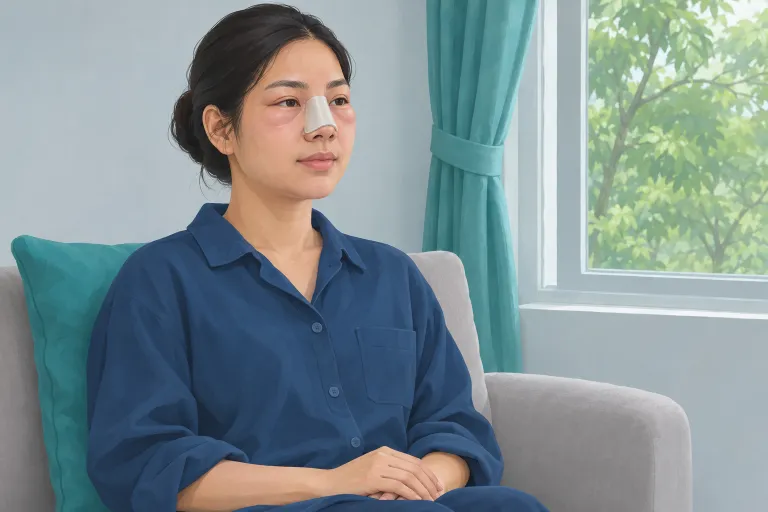
Cleveland Clinic describes swelling for four to six weeks, about 90% gone at three months, and possible residual swelling at one year.
One 2016 Yale study in the United States measured 146 three-dimensional photographs from 40 patients having their first open rhinoplasty. Its model estimated about two-thirds of swelling resolved in the first month, 95% by six months and 97.5% by one year.
That study excluded closed, repeat and cleft procedures. So ask your surgeon how closely your operation matches the study group.
Phuket Plastic Surgery Institute (PPSI) prints full recovery at two weeks in its summary, while the same page says final results may take 12 months.
PPSI also says bruising and swelling should have subsided after two weeks. Kamol Hospital describes temporary bruising or swelling for two to three weeks, a good idea of the final result taking up to four months, and the full outcome up to one year.
The agency CosMediTour gives longer swelling windows. Its aftercare PDF says swelling can last up to 24 months; its expectations PDF says subtle tip and bridge swelling may take over 12 months to resolve.
These are the agency's instructions. Ask the operating surgeon which timeline fits the surgery being proposed.
Rhinoplasty aftercare: follow the operating surgeon's instructions
ASPS says patients receive instructions on wound care, concerns to watch for and follow-up. Use the consultation to get the instructions in writing, including what changes if healing takes longer.
Flying home after rhinoplasty from Thailand
ASPS suggests waiting seven to 10 days before flying after facial cosmetic procedures, explicitly including rhinoplasty. The NHS says air travel and major surgery increase blood-clot risk.
Thailand stay instructions can extend beyond that interval. PPSI says: "You may be required to remain in Thailand for 2 weeks for your surgeon to monitor your progress."
Kamol's recovery page prints a minimum Thailand stay of 10 to 14 days for rhinoplasty. It places stitch removal five to 10 days after surgery and surgeon follow-up at 10 to 14 days.
Destination Beauty, a surgery-travel agency, says one procedure may need about 10 to 14 nights in Thailand. That is its general planning guidance across procedures.
So ask the hospital to put follow-up and removal appointments beside your proposed return date when planning rhinoplasty in Bangkok. Ask for written flight approval for your own recovery, and confirm what happens if the surgeon asks you to stay longer.
What recovery planning in Thailand should include
PPSI lists one hospital night with general anesthesia and zero nights with local anesthesia. The same page separately describes a possible two-week Thailand stay for monitoring.
Bangkok Hospital Headquarters says silicone augmentation patients may go home after surgery, while its cartilage procedure requires one hospital night. So ask how much of your trip will be in hospital and where you will stay afterward.
Destination Beauty states: "Once you leave Thailand, Destination Beauty and your Thai surgeon cannot provide hands-on medical care." Its FAQ says hands-on care after departure must take place locally.
CosMediTour's aftercare PDF advises a check with a general practitioner within one week of returning home. Ask who will see you locally and what documents they need.
When reviewing rhinoplasty clinics in Thailand, request each surgeon's written aftercare plan. Use these questions before booking:
Risks, complications, and what to arrange before you travel
ASPS's rhinoplasty risk list includes infection, difficulty breathing, poor healing or scarring, altered skin sensation, and an unsatisfactory appearance. It also lists further surgery as a possibility.
ASPS includes a hole in the septum, the partition inside the nose, among the possible complications. The NHS also lists heavy nosebleeds and an altered sense of smell.
Ask the surgeon to explain which symptoms need urgent assessment and where you should go. Get a contact for concerns during the Thailand stay and arrange who can examine you after you return.
The NHS advice on surgery abroad says travel insurance does not normally cover things going wrong in surgery. So check the actual policy before booking and ask how care for a complication would be paid for.
Results and revision: allow time before judging the outcome
ASPS describes gradual changes in nasal shape as swelling settles. Ask the surgeon when photographs should be taken to assess your progress.
When looking at rhinoplasty before-and-after photos, ask how long after surgery each image was taken. ASPS's photo guidance also advises checking whether the lighting, angle and pose match.
ASPS cautions that results may not be completely symmetrical, and its risk guidance includes the possibility of revision surgery. Ask when your surgeon would assess a concern about appearance and how they decide whether further surgery is appropriate.
Frequently asked questions
How long does rhinoplasty recovery take?
The NHS says you may need up to two weeks off work and should avoid strenuous exercise or contact sports for four to six weeks. ASPS says the nasal shape can take up to a year to fully refine.
How long does rhinoplasty swelling last?
The NHS gives up to six months for swelling to completely settle. ASPS says it can come and go during the first year, including being worse in the morning.
What rhinoplasty aftercare should I expect?
ASPS suggests asking when dressings and stitches will be removed. It also recommends asking about follow-up and returning to exercise. Get the operating surgeon's written instructions, including nose blowing, glasses and swimming, and confirm any removal appointments before departure.
When can I fly after rhinoplasty?
ASPS suggests waiting seven to 10 days. Ask the surgeon to assess your planned departure against your recovery and follow-up appointments; Kamol, for example, schedules rhinoplasty follow-up at 10 to 14 days.
How long should I stay in Thailand after rhinoplasty?
PPSI says you may need to remain for two weeks for monitoring; Kamol prints 10 to 14 days. The agency Destination Beauty gives about 10 to 14 nights for one procedure across its surgery program.
When can I wear glasses or exercise after rhinoplasty?
PPSI says no glasses for one month, and Kamol says four weeks. The NHS says to avoid strenuous exercise or contact sports for four to six weeks; confirm your own instructions with the surgeon.
Read next
- Open vs closed rhinoplasty: how the two approaches differHow open and closed rhinoplasty differ in incision, scar, swelling and what each suits, and what to ask a Thai surgeon about the approach.
- Asian rhinoplasty: implants, cartilage and what to askWhat Asian and augmentation rhinoplasty involve, silicone implants vs your own cartilage, the risks studies report, and what Thai hospitals print.
- Revision rhinoplasty: why noses get redoneWhy a nose gets operated on again, how often studies report it, implant problems, how long to wait, and what Thai hospitals print about revision.
- Are rhinoplasty results permanent? What changes over timeHow long rhinoplasty results last, when the final shape shows, what can change over the years, implant and cartilage differences and when revision is considered.
Ask the Hospital How Long to Stay Before You Fly Home
Tell us the procedure, your budget and your dates, and any hospitals you are considering.
Get My Free Quote →Free, no obligation. Nothing goes to a clinic without your OK.