Revision Rhinoplasty: Risks, Recovery and Planning a Second Nose Surgery
Revision rhinoplasty is further surgery after an earlier nose operation, also called secondary rhinoplasty by Cleveland Clinic. The American Society of Plastic Surgeons (ASPS) describes complex underlying problems in revision cases.
If you're considering rhinoplasty in Thailand, ask for an explanation of the proposed revision before choosing travel dates. This is general information, not a personal surgical recommendation.
Clinics cannot pay to be listed or ranked higher on AsiaPatient.
What revision rhinoplasty means, and why patients consider it
Cleveland Clinic describes secondary rhinoplasty as revising or correcting problems after the first operation. It says those problems can be minor but are often more complex to repair.
Tell the surgeon what concerns you now and what changed after the earlier operation. Ask which concerns could be addressed and which might remain.
Cosmetic and functional concerns can overlap
ASPS describes rhinoplasty as changing appearance and correcting impaired breathing caused by structural problems. Its risk guidance also lists difficulty breathing and an unsatisfactory nasal appearance after surgery.
So describe breathing symptoms even if your main concern is the shape. Ask whether the proposed operation addresses appearance, breathing or both, and how each concern will be assessed.
A surgeon needs the original procedure history
The agency Destination Beauty says its suitability review considers medical history, earlier procedures, current concerns and expectations. It makes final approval subject to surgeon consultation and hospital clearance.
Ask the surgeon's office which records from your earlier treatment it wants before consultation. Explain any previous implant or cartilage graft you know about, and ask how uncertain details will be checked.
When revision should be assessed
ASPS's recovery guidance says initial swelling subsides within weeks, while the nasal contour may take up to a year to fully refine. Ask your surgeon when your current appearance can be assessed and when another operation could be considered.
ASPS says swelling can come and go during the first year, including being worse in the morning.
Healing changes what can be judged
Cleveland Clinic says full recovery can take up to a year. Ask which changes the surgeon expects from continued healing and which concerns need a separate assessment.
Keep the assessment date and any proposed surgery date separate when discussing the plan. Ask what the surgeon wants to review before deciding whether to operate again.
Earlier assessment can still matter when there is a concern
Contact the treating team promptly about symptoms or concerns after surgery. Ask how to reach a clinician between scheduled visits and what to do if you're already home.
That contact plan matters alongside the risks ASPS lists, including infection, breathing difficulty and poor wound healing. Don't use a planned future revision consultation as your only point of contact for a current concern.
How a revision may be planned
The ASPS nasal surgery practice parameter says an open approach may suit revision because it allows assessment and access in complex anatomy. Ask the surgeon to explain the access needed for your proposed correction.
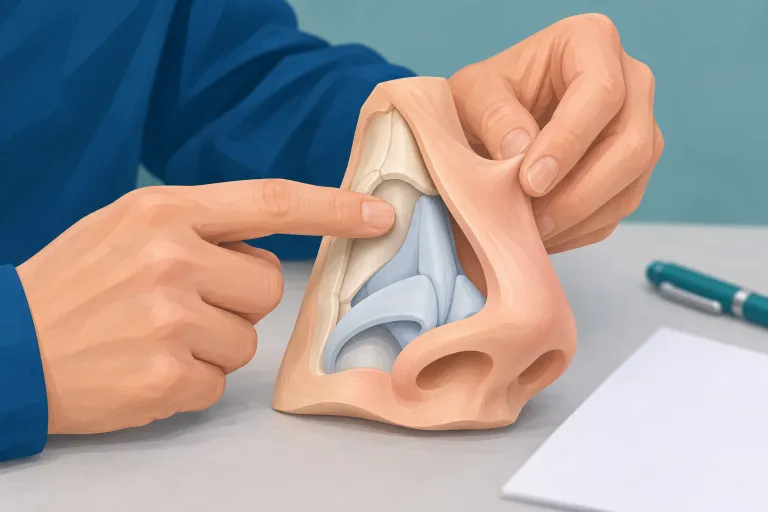
Open and closed approaches
Cleveland Clinic describes open rhinoplasty as separating skin from bone and cartilage for major reshaping. It describes closed rhinoplasty as using incisions inside the nose for minor reshaping.
One 2025 systematic review by Abi Zeid Daou and colleagues, based at the American University of Beirut Medical Center in Lebanon, pooled data from 12 studies involving 1,067 adults. It found no significant difference in measured appearance and obstruction scores, swelling, bruising, operating time, satisfaction or complications.
The review rated study quality as moderate, and the appearance and obstruction analyses varied substantially between studies. Ask how the surgeon's proposed approach relates to your previous surgery and current anatomy.
Cartilage, implants and nose implant removal
ASPS's procedure guide says cartilage used for grafting most commonly comes from the septum, the partition inside the nose. It identifies ear cartilage as an occasional source and rib cartilage as a rare one.
Bangkok Hospital describes cartilage augmentation for people who don't want silicone, or whose earlier rhinoplasty problems make silicone unsuitable. Its listed sources are "ear cartilage, septal cartilage and rib cartilage."
Kamol Hospital's technique page lists synthetic implant materials including silicone and "ePTFE". Ask which material is currently in your nose and whether the proposed operation would retain, remove or replace it.
What a patient can ask about an implant plan
Use the material options described by ASPS and Bangkok Hospital to prepare your consultation questions:
Ask for the proposed material and follow-up plan in writing. If the plan changes at consultation, ask for the revised explanation before agreeing to surgery.
Rhinoplasty risks, including risks that matter in revision
All surgery carries risk, as the ASPS cosmetic surgery tourism briefing emphasizes. Its rhinoplasty safety page lists infection, breathing difficulty, poor healing or scarring, skin discoloration and swelling, and an unsatisfactory appearance.
ASPS also lists a hole in the nasal septum, which it calls rare, and the possibility of further surgery. Cleveland Clinic adds nosebleeds, an altered sense of smell and pain.
Ask the surgeon which risks apply to the proposed revision and how a complication would be managed. Ask where treatment would happen if a problem arose after discharge.
What one US revision study reported
One US study by Spataro and colleagues, published in 2016, examined 175,842 septorhinoplasty patients (nose and nasal septum surgery) in California, Florida and New York. Operations took place from 2005 through 2009, with database follow-up through 2012.
The study reported further revision in 11.0% of 3,518 secondary cases, compared with 3.1% of 172,324 primary cases. Those figures come from one US database cohort.
Material-specific risks need careful context
One 2016 study by Joo and colleagues reviewed 244 augmentation rhinoplasty patients treated by the same surgeon in the Republic of Korea. It reported complications in both the synthetic ePTFE implant group and the patients' own rib-cartilage group.
The study was a retrospective review. Ask why a material is proposed for your revision and how the surgeon weighs its risks against the other options.
Recovery and aftercare after a revision
Ask for recovery instructions for the proposed operation. The following sources describe general rhinoplasty care or their own hospital schedules; each timing below belongs to the source that gives it.
| Stage | What the source says | Source type | Question for your surgeon |
|---|---|---|---|
| Splint removal | The ASPS practice parameter gives usual removal at 7 to 10 days | Professional society | When would my splint be removed? |
| Follow-up and stitches | PPSI's instructions schedule surgeon review and suture removal 5 to 7 days "after discharge" | Hospital instructions | What date is discharge, and when is my appointment? |
| Nose blowing and activity | The ASPS practice parameter says no sniffing or nose blowing for 3 to 4 weeks and no strenuous activity for one month | Professional society | Which restrictions apply to my revision? |
| Swelling and shape | ASPS says the contour may take up to a year to refine | Professional society | When should we reassess the shape? |
| Time in Thailand | Kamol's facial-surgery table, which includes rhinoplasty, gives 10 to 14 days under "Total Length of Stay (Minimum)" | Hospital travel plan | How long do you want me nearby? |
| Flight planning | ASPS suggests 7 to 10 days before flying after facial cosmetic procedures, including rhinoplasty | Professional society | When can I fly after my operation? |
Aftercare instructions vary by hospital
Phuket Plastic Surgery Institute (PPSI) describes "cold compression" during the first three days, changing to "warm compression" from day four. It schedules surgeon follow-up and stitch removal five to seven days after discharge.
Bangkok Hospital instructs patients to keep the nose dry for "at least 5 days after surgery" and avoid possible nasal trauma for at least one month. So ask your treating team which instructions it wants you to follow.
Results need time
PPSI's rhinoplasty page prints different recovery milestones on the same page:
| PPSI section | Printed timing |
|---|---|
| At-a-glance panel | "Full Recovery": "2 Weeks" |
| Results text | Final result may take up to "12 months" |
Ask PPSI what each term means for your proposed revision. Keep both statements in the discussion.
Kamol Hospital says a good idea of the final result may take up to four months, while the outcome may take up to one year. Ask when the surgeon plans to assess the result of your operation.
What this means for a patient flying to Thailand
Kamol's travel plan lists "Once daily wound dressing" for its facial-surgery group, including rhinoplasty. It places stitch removal sometime five to ten days after surgery and surgeon follow-up sometime ten to fourteen days after surgery.
For location planning, see rhinoplasty in Bangkok. Ask for appointment dates before choosing accommodation and flights.
Hospital stay lengths and flight timing
PPSI says patients may need to "remain in Thailand for 2 weeks" for monitoring. Kamol prints a minimum stay of 10 to 14 days for its facial-surgery group, including rhinoplasty.
Separately, ASPS suggests waiting 7 to 10 days before flying after facial cosmetic procedures, including rhinoplasty. Discuss your departure with the treating surgeon and confirm which appointments must happen first.
Plan the return-home handoff
The agency Destination Beauty says hands-on care after leaving Thailand must take place locally. Before booking, ask who would examine you at home, how they would receive your surgical information, and how to contact the Thai team.

When assessing results, use how to assess rhinoplasty before-and-after photos. ASPS advises comparing angle, lighting and pose, and asking when the photos were taken.
The ASPS gallery cautions that patients won't all achieve the results shown. Ask to discuss expectations for your own operation.
For surgeon checks, see rhinoplasty clinics in Thailand. Check the surgeon's name against the Medical Council of Thailand register.
The Society of Plastic and Reconstructive Surgeons of Thailand directory lists full members, with some choosing not to display a profile. Use it as a membership directory alongside the licensing check.
Alternatives to another operation
You can decide against further surgery. Ask what waiting or having no additional treatment would mean for your current concerns.
Cleveland Clinic describes filler rhinoplasty as temporary treatment for dips or irregularities, a drooping tip or a small bump. Ask whether it is appropriate after your previous operation, what its risks would be, and whether it addresses the concern you want treated.
Frequently asked questions
What is revision rhinoplasty?
Cleveland Clinic calls it secondary rhinoplasty: surgery to revise or correct problems after the first rhinoplasty. Ask the surgeon to specify the problem and proposed correction.
How long should I wait before revision rhinoplasty?
Ask your surgeon when another operation could be considered. ASPS says the nasal contour may take up to a year to refine after rhinoplasty.
Can revision rhinoplasty help breathing problems?
ASPS describes correcting impaired breathing from structural problems as one purpose of rhinoplasty, and its risk guidance lists difficulty breathing after surgery. Ask what is causing your symptoms and whether the proposed revision addresses that cause.
Is revision rhinoplasty riskier than the first operation?
ASPS says revision surgery can be more complicated than the initial operation. Ask the surgeon to explain the risks for your anatomy and previous treatment, including the possibility of another operation.
Does revision rhinoplasty always require rib cartilage or implant removal?
ASPS lists septal and ear cartilage as graft sources as well as rib cartilage. Ask which material the surgeon proposes and why, and whether any existing implant would stay, be removed or be replaced.
How long should I stay in Thailand after revision rhinoplasty?
PPSI says a two-week stay may be required for monitoring; Kamol gives 10 to 14 days minimum in its facial-surgery plan. ASPS separately suggests 7 to 10 days before flying after facial cosmetic procedures, including rhinoplasty.
Ask your surgeon to set the local follow-up schedule and assess your departure date for the proposed revision.
Read next
- Are rhinoplasty results permanent? What changes over timeHow long rhinoplasty results last, when the final shape shows, what can change over the years, implant and cartilage differences and when revision is considered.
- Rhinoplasty Cost in Thailand: Hospital Price Lists (2026)Rhinoplasty in Thailand from the hospitals' own price pages: Yanhee, Bangkok Hospital, PPSI, Rattinan, what each row includes, agency add-ons, trip budget.
- Rhinoplasty in BangkokWhich Bangkok hospitals and clinics print a nose surgery price, where they are and how to check the surgeon.
- Rhinoplasty clinics in Thailand comparedThe Thai hospitals and clinics that do nose surgery, compared on printed prices, accreditation and named surgeons.
Send Your Records and Ask What a Revision Would Involve
Tell us the procedure, your budget and your dates, and any hospitals you are considering.
Get My Free Quote →Free, no obligation. Nothing goes to a clinic without your OK.