Open vs Closed Rhinoplasty: Differences, Recovery and Thailand Travel Planning
Open and closed are approaches to rhinoplasty in Thailand that describe how the surgeon reaches the nose's underlying structures, as Cleveland Clinic explains. A 2025 systematic review and meta-analysis found no significant difference in the outcomes it measured between the approaches.
Ask the surgeon why the proposed approach fits your nose and planned changes. AsiaPatient doesn't choose a surgical technique for you.
Clinics cannot pay to be listed or ranked higher on AsiaPatient.
What open and closed rhinoplasty mean
The American Society of Plastic Surgeons (ASPS) describes rhinoplasty as changing nasal proportions and addressing breathing problems caused by structural issues. So discuss both appearance and breathing at consultation, even if your initial concern is cosmetic.
Open rhinoplasty
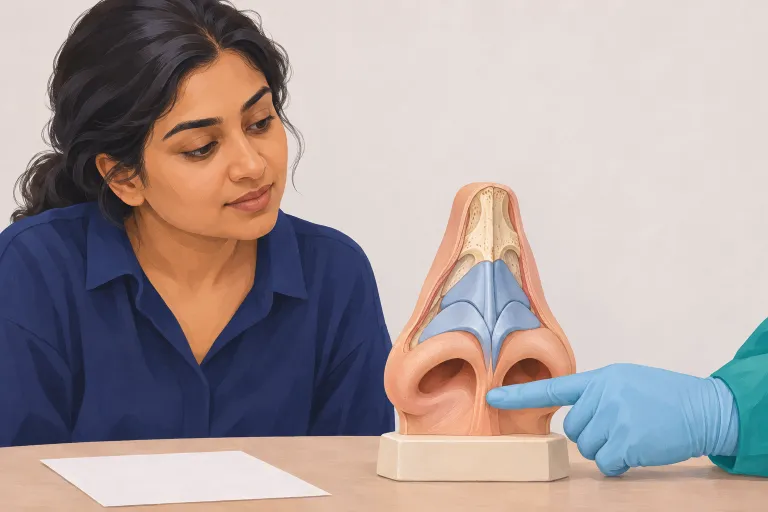
Open rhinoplasty adds an incision across the columella, the tissue between the nostrils, to internal access. Bangkok Hospital Headquarters describes a "small incision on the columella" that gives access to bone and cartilage.
Cleveland Clinic describes open rhinoplasty as major reshaping, with the skin separated from the underlying structures so the surgeon can see them clearly. Ask where the external incision would sit and how the surgeon expects it to heal.
Closed rhinoplasty
Cleveland Clinic describes closed rhinoplasty as minor reshaping through incisions inside the nose. Kamol Hospital uses the phrase "less extensive reshaping" for this approach.
Ask the surgeon to describe the changes they would make through those incisions. If scar visibility is a concern, ask which incisions the complete operation would require.
Open vs closed rhinoplasty at a glance
| Approach | Incision access | Hospital description | Comparative evidence |
|---|---|---|---|
| Open | A columellar incision, as described by Bangkok Hospital | Kamol describes "greater access and more complex reshaping" | The 2025 meta-analysis found no significant difference in its measured outcomes |
| Closed | Incisions inside the nose, per Cleveland Clinic | Kamol describes less extensive reshaping | Same review, same finding |
Use these descriptions to ask about the proposed operation. Request an explanation of why the surgeon considers that access appropriate for your planned changes.
How the approach is chosen
Cleveland Clinic's candidacy guidance includes completed growth, good physical health, not smoking and reasonable goals. It also says the decision should be made for your own reasons.
Bring your priorities to the consultation and ask how the surgeon has assessed them. Ask which changes are realistic and what limitations you should expect.
A first operation versus revision rhinoplasty
Revision means another operation after earlier rhinoplasty. Cleveland Clinic describes it as addressing problems after the first surgery.
Ask how any earlier surgery affects the proposed approach. Request an explanation of what needs changing and why the surgeon plans to use open or closed access.
Questions to ask at consultation
Ask the surgeon to explain the approach as part of your full surgical plan.
Ask for the answers in writing. Keep the proposed approach, material and follow-up schedule with the operation details.
What the evidence says about results
One 2025 systematic review and meta-analysis by Abi Zeid Daou and colleagues included 20 studies. The research team was based in Lebanon; 12 studies supplied the pooled data on 1,067 adults.
The review found no significant differences in questionnaire scores for rhinoplasty outcomes and nasal obstruction, called ROE and NOSE scores. It also found no significant differences in swelling, bruising, operating time, satisfaction or complication rates. The authors rated study quality as moderate and reported high variation between studies in the questionnaire analyses.
Ask how those findings apply to your proposed operation and medical history. If a consultation includes a claim that one approach gives better results, ask which comparison supports it and which patients it studied.
Results take time to settle
One 2016 US study by Pavri and colleagues at Yale followed swelling in 40 primary open-rhinoplasty patients using three-dimensional photographs. It estimated that about two-thirds of swelling resolved in the first month, 95% by six months and 97.5% by one year.
That study excluded closed and revision procedures.
Cleveland Clinic says full recovery can take up to a year. Ask when your surgeon wants to assess healing and when they expect to discuss the settled result.
A temporary non-surgical alternative
Cleveland Clinic describes filler rhinoplasty as a temporary option for dips, irregularities, a droopy tip or a small bump. Ask whether it addresses your concern and what risks, limits and repeat treatment it would involve.
Recovery and aftercare after either approach
Ask for recovery instructions for the operation you're planning. Keep splint removal, return to work and later swelling reviews as separate appointments or milestones.
| Milestone | Source's timing | Source type |
|---|---|---|
| Splint removal | Usually seven to 10 days | ASPS practice parameter, 2006 professional guidance |
| Splint use | One or two weeks | Cleveland Clinic, general patient guidance |
| Work or school | One to two weeks | Cleveland Clinic, general patient guidance |
| Swelling measurement through one year | 97.5% reduction by one year in the studied group | Pavri and colleagues, one 2016 US study of 40 primary open cases |
Ask your surgeon which timing they expect for you and what could change it. Include the demands of your work when asking about time off.
Aftercare instructions from Thai hospitals
Phuket Plastic Surgery Institute (PPSI) gives instructions for "cold compression" during the first three days and warm compression from day four. It schedules the surgeon's follow-up and stitch removal five to seven days after discharge.
PPSI's instruction page says to avoid heavy lifting and strenuous exercise for two weeks. Its rhinoplasty service page says to avoid strenuous activity for one month.
That service page also puts "2 Weeks" beside "Full Recovery", while its results paragraph says the final result might take up to 12 months. Ask PPSI which activity and recovery instructions apply to your operation.
Bangkok Hospital describes a "3-day continuous cold compress". It says to keep the nose dry for at least five days and the splint or cast dry for at least four to five days.

The hospital also instructs patients to attend all follow-ups and avoid potential nasal trauma for at least one month. Ask your treating team to explain how to follow its instructions at your accommodation.
What to plan before leaving Thailand
PPSI's rhinoplasty page says patients might be required to "remain in Thailand for 2 weeks" for monitoring. Ask for the proposed hospital nights and local appointment dates separately.
Kamol Hospital's travel page lists rhinoplasty in its facial-surgery group and prints 10 to 14 days under "Total Length of Stay (Minimum)". It places stitch removal five to 10 days after surgery and surgeon follow-up 10 to 14 days after surgery.
For flying, ASPS suggests waiting seven to 10 days after facial cosmetic procedures, including rhinoplasty. Ask your surgeon to confirm your departure plan and which appointments must happen first.
So get the local follow-up schedule before setting your return date. For location planning, see rhinoplasty in Bangkok.
Risks to discuss before choosing a technique
ASPS lists rhinoplasty risks including anesthesia complications, changes in sensation, breathing difficulty, infection and poor healing or scarring. ASPS also lists swelling and skin discoloration. An unsatisfactory appearance and further surgery are possible.
ASPS also lists septal perforation, a hole in the wall dividing the nose. Ask the surgeon to explain the risks of your complete operation and how complications would be managed.
Grafts and implants are a separate decision
ASPS says cartilage grafts most commonly come from the septum, the partition inside the nose, occasionally from the ear and rarely from the rib. A graft is tissue used as part of the reconstruction.
Kamol's rhinoplasty page also lists "Silicone implants" and "ePTFE (Gore-Tex)", a synthetic implant material. Ask which material is proposed, why it is being used and whether obtaining cartilage would require another surgical site.
Ask about the risks of the material alongside those of the approach. Request the material name in your written surgical plan.
When to seek local help after returning home
Before leaving Thailand, ask who can examine you in person at home if you have a concern. Ask the surgeon which symptoms require urgent local care and which should prompt a routine follow-up.
Request written contact details for the operating team and a plan for sharing your operation notes with a local clinician. Include those arrangements when considering how to compare rhinoplasty clinics.
Frequently asked questions
What is the difference between open and closed rhinoplasty?
Cleveland Clinic describes closed access through internal incisions. Bangkok Hospital describes open access with an incision across the columella between the nostrils.
Is open or closed rhinoplasty better?
The 2025 meta-analysis found no significant difference in its measured outcomes. Ask your surgeon why the proposed approach fits the changes you want and the anatomy they have assessed.
Does open or closed rhinoplasty recover faster?
The 2025 meta-analysis found no significant difference in swelling or bruising. Ask for the expected recovery schedule for your full operation, including any graft work.
How long should I stay in Thailand after rhinoplasty?
PPSI says monitoring might require a two-week stay. Kamol prints a minimum stay of 10 to 14 days for its facial-surgery group, which includes rhinoplasty.
ASPS's seven-to-10-day flying suggestion is general guidance. Confirm your local appointments and flight timing with your surgeon.
Can I see rhinoplasty before-and-after photos before choosing a surgeon?
Ask the surgeon to discuss examples with you. ASPS advises asking when the photos were taken and whether they represent typical outcomes.
The same ASPS article advises comparing lighting, camera angles and pose. Ask which approach and materials were used in the cases you discuss.
Continue your Thailand rhinoplasty research
For price and package questions, see rhinoplasty cost in Thailand. Use the surgeon's proposed operation when requesting an itemized quote.
For image questions, see rhinoplasty before-and-after photos. ASPS cautions that patients won't all achieve the same results shown in its gallery.
Read next
- Asian rhinoplasty: implants, cartilage and what to askWhat Asian and augmentation rhinoplasty involve, silicone implants vs your own cartilage, the risks studies report, and what Thai hospitals print.
- Revision rhinoplasty: why noses get redoneWhy a nose gets operated on again, how often studies report it, implant problems, how long to wait, and what Thai hospitals print about revision.
- Are rhinoplasty results permanent? What changes over timeHow long rhinoplasty results last, when the final shape shows, what can change over the years, implant and cartilage differences and when revision is considered.
- Rhinoplasty Cost in Thailand: Hospital Price Lists (2026)Rhinoplasty in Thailand from the hospitals' own price pages: Yanhee, Bangkok Hospital, PPSI, Rattinan, what each row includes, agency add-ons, trip budget.
Ask Which Approach the Surgeon Plans for Your Nose
Tell us the procedure, your budget and your dates, and any hospitals you are considering.
Get My Free Quote →Free, no obligation. Nothing goes to a clinic without your OK.