Asian Rhinoplasty: Techniques, Silicone Implants and Recovery
Asian rhinoplasty is a search term for plans that can include bridge augmentation, tip work or reshaping, using implants or cartilage grafts. If you're considering rhinoplasty in Thailand, start with your own goals: Cleveland Clinic says candidates should understand the operation's limits and want surgery for their own reasons.
Ask the surgeon which features you want to preserve as well as change. Your heritage shouldn't stand in for that conversation.
AsiaPatient isn't a hospital, clinic, agency or marketplace and doesn't assess individual suitability. Clinics cannot pay to be listed or ranked higher on AsiaPatient.
What Asian rhinoplasty and augmentation rhinoplasty can involve
The American Society of Plastic Surgeons (ASPS) describes rhinoplasty as changing nasal proportions and addressing impaired breathing caused by structural problems. Tell the surgeon whether your concern involves appearance, breathing or both.
Augmentation means building up the nasal bridge, also called the dorsum. Fisher's 2022 review of dorsal augmentation describes cartilage grafts and artificial implants among the material options.
Ask what the proposed operation changes at the bridge and what it changes elsewhere. A plan described as augmentation can still leave you needing a separate explanation of the intended tip work.
Open and closed approaches
Bangkok Hospital describes closed surgery with incisions "hidden inside the nose". For open surgery, it describes an incision across the columella, the strip of tissue separating the nostrils, to access the underlying structure.
Abi Zeid Daou's 2025 systematic review and meta-analysis pooled data from 12 studies covering 1,067 adults. The Lebanon-based research team found no significant differences in the measured outcomes, including satisfaction, along with complications and breathing-related scores.
The authors rated study quality as moderate and reported substantial variation between studies in some analyses. Ask why the surgeon proposes one approach for your operation.
Changes a surgical plan may include
Kamol Hospital lists "Hump Reduction" and "Tip Shortening" among its techniques. It also describes bridge reduction, tip correction and correction of a drooping tip.
Kamol's page also lists lateral osteotomy, spreader grafting and septoplasty, along with perinasal augmentation and alarplasty. Ask the surgeon to explain any of these terms on your plan, mark the intended changes on your photographs and describe their purpose.
You don't have to ask for every technique on a hospital's menu. Ask which parts of the plan address the concerns you brought to the consultation.
Silicone nose implant or cartilage graft: material choices
Synthetic implants are also called alloplastic materials. Keyhan's 2022 review covers silicone, expanded polytetrafluoroethylene (ePTFE) and high-density polyethylene for building up the bridge.
Autologous means tissue from your own body. Fisher's dorsal augmentation review lists cartilage from the septum, ear and ribs as autologous graft sources.
So ask for the proposed material at each part of your nose. If the plan combines an implant and cartilage, ask what each component is intended to do.
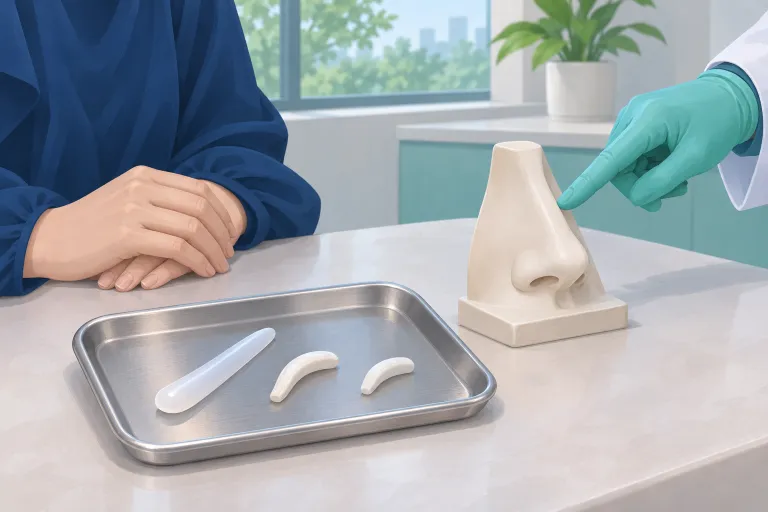
Silicone and other synthetic implants
One 2022 systematic review and meta-analysis by Keyhan and colleagues included 3,803 cases across 27 observational studies. It covered silicone, ePTFE and high-density polyethylene.
The review reported a pooled revision rate of 6.40%. Ask the surgeon what could lead to a revision and how it would be handled.
This figure belongs to the review's mixed materials and study populations. Ask the surgeon how the proposed implant compares with the materials and operations included in that research.
Septal, ear, and rib cartilage
ASPS says added cartilage most commonly comes from the septum, the partition inside the nose. It describes ear cartilage as an occasional source and rib cartilage as a rare source in its general procedure guide.
Rib harvesting adds a surgical site at the chest. The 2020 review Complications of Costal Cartilage Asian Rhinoplasty and Their Management lists pain, chest scars and pneumothorax, a collapsed lung, among donor-site concerns.
The same review lists graft warping, infection and displacement. Include the chest incision and its care in the consultation if the surgeon proposes your own rib cartilage.
How to read comparative evidence
One 2022 meta-analysis by Wu and colleagues included seven articles and 1,233 rhinoplasty patients. The China-based authors reported higher satisfaction and lower total complication and secondary-surgery risk with autologous cartilage than silicone.
Wu and colleagues also flagged differences between studies and possible publication bias, meaning the published studies may not represent all research results.
A separate 2016 retrospective study by Joo and colleagues reviewed 244 augmentation patients in the Republic of Korea. It compared 176 ePTFE patients with 68 receiving their own rib cartilage and reported similar aesthetic scores, with complications in 4.0% and 11.8%, respectively.
That Korean study used a different implant comparison and wasn't randomized. Discuss the proposed material alongside the operation's purpose and whether you're having first-time or revision surgery.
Candidacy and expectations need an individual consultation
Cleveland Clinic describes candidates as physically healthy, finished growing and nonsmoking. It also calls for reasonable goals, an understanding of surgery's limitations and a decision made for your own reasons.
Ask the surgeon to assess those points with your health history. If you're seeking a change in appearance, explain what you want to keep as well as what you want changed.
The questions a consultation needs to resolve
Use the ASPS procedure explanation and risk list to prepare questions for the operating surgeon:
Ask for the proposed operation and follow-up schedule in writing.
If the explanation uses only "Asian rhinoplasty" or "ethnic rhinoplasty," ask for the actual procedures and materials. Include any changes you don't want in that discussion.
Recovery and results: plan for months, not days
Swelling might persist for a year. Cleveland Clinic describes residual swelling during that period and says healing varies between people.
One 2016 study by Pavri and colleagues at Yale in the United States examined 40 primary open-rhinoplasty patients. Its model estimated that about two-thirds of swelling resolved in the first month, 95% by six months and 97.5% by one year.
| Stage | Attributed timing | Source type and scope |
|---|---|---|
| Splint | Cleveland Clinic: one or two weeks | General rhinoplasty guidance |
| Work or school | Cleveland Clinic: one to two weeks | General guidance; discuss your work with the surgeon |
| Light exercise | Cleveland Clinic: four to six weeks | General activity guidance |
| Swelling at six months | Pavri's US study: 95% resolved | Model from 40 primary open cases |
| Swelling at one year | Pavri's US study: 97.5% resolved | Same study; closed and revision cases excluded |
So ask for your own timetable for work, exercise and reviews. Keep the study's primary open-surgery population in mind when discussing its swelling estimates.
Aftercare instructions can differ by hospital
The Phuket Plastic Surgery Institute (PPSI) advises cold compression during the first "3 days" and warm compression from the "fourth day". Bangkok Hospital describes a "3-day continuous cold compress" and keeping the nose dry for "at least 5 days".
Kamol Hospital advises avoiding strenuous activity for "at least two weeks". Ask your operating team for its instructions rather than combining hospital schedules yourself.
PPSI's rhinoplasty page presents different recovery statements side by side: its summary labels "Full Recovery" as "2 Weeks" while its detailed text says the final results may take up to 12 months. Ask your hospital how any summary panel applies to your planned operation.
For photographs, ASPS advises checking consistent lighting, angles and poses, and asking when postoperative images were taken. See how to assess rhinoplasty before-and-after photos for those questions.
Risks to discuss before rhinoplasty
ASPS's rhinoplasty safety page lists these possible risks:
- Anesthesia risks and changes in skin sensation
- Breathing difficulty and infection
- Septal perforation, a hole in the partition inside the nose, which ASPS calls rare
- Poor wound healing or scarring
- Further surgery
- Skin discoloration and swelling
- An unsatisfactory nasal appearance
Ask which risks matter most for your proposed operation. Request an explanation of what would happen if breathing or appearance worsened after surgery.
Implant and graft-specific concerns
Choi's 2020 review of alloplastic implant complications, written in the Republic of Korea, describes reported infection, extrusion and movement. It also lists irregularities, absorption, prolonged swelling, seroma and contracture.
For your own rib cartilage, the 2020 costal-cartilage complications review lists warping, infection and displacement alongside chest-site problems. Ask about both the graft and the area where cartilage would be taken.
Revision changes the evidence and the discussion
ASPS's cosmetic surgery tourism paper says revision surgery after treatment abroad can be more complicated than the original operation. Ask how the surgeon distinguishes first-time and revision cases when discussing results and complications.
If a study comes up during that discussion, ask who was included. Were they people having their first operation, people having revision surgery, or patients already seeking help for a complication?
Tell the surgeon about every previous nose operation and any implant you already have. Ask how that history changes the proposed material and follow-up plan.
What this means if you are flying to Thailand
ASPS's cosmetic surgery tourism guidance suggests waiting seven to 10 days before flying after facial cosmetic procedures, explicitly including rhinoplasty. Ask your surgeon for individual clearance before setting your departure date.
Kamol's recovery page lists 10 to 14 days under "Total Length of Stay (Minimum)" for its facial-surgery group, which includes rhinoplasty.
So allow for the hospital's scheduled appointments when discussing travel. Ask how the plan changes if healing delays your departure.
Build follow-up into the travel plan
PPSI's instructions schedule surgeon follow-up and stitch removal five to seven days "after discharge". So confirm both the discharge date and appointment date with the hospital.

The agency Destination Beauty says: "Once you leave Thailand, Destination Beauty and your Thai surgeon cannot provide hands-on medical care." Ask who will examine you locally if a concern needs an in-person assessment.
For location and selection questions, read rhinoplasty in Bangkok and how to compare rhinoplasty clinics. The separate rhinoplasty cost in Thailand page covers published prices.
Frequently asked questions
What is Asian rhinoplasty?
It's a broad search label for rhinoplasty plans that may include bridge augmentation and reshaping. Fisher's 2022 review describes several implant and graft options; ask the surgeon to explain the changes proposed for your own nose and goals.
What is augmentation rhinoplasty?
It means building up the nasal bridge. Fisher's review of dorsal augmentation describes options including your own cartilage and artificial implants.
Is a silicone nose implant safer than cartilage?
Wu's 2022 meta-analysis of seven articles and 1,233 patients, by China-based authors, favored autologous cartilage on its measured outcomes but flagged differences between studies and publication bias. Ask the surgeon to discuss material risks in the context of your proposed operation and any previous surgery.
What risks come with a silicone nose implant?
Choi's 2020 review includes silicone among artificial implant materials and reports concerns including infection, extrusion, movement and irregularities. Ask which of its other reported concerns apply to the proposed implant, including absorption, prolonged swelling, seroma or contracture.
How long does recovery take after Asian rhinoplasty?
Cleveland Clinic gives one or two weeks for a splint and one to two weeks for returning to work or school. It says residual swelling can persist for a year and recovery varies between people.
When can I fly after rhinoplasty in Thailand?
ASPS suggests waiting seven to 10 days after facial cosmetic procedures, including rhinoplasty. Ask your operating surgeon to confirm when you can fly and which follow-up appointments you need before leaving Thailand.
Read next
- Revision rhinoplasty: why noses get redoneWhy a nose gets operated on again, how often studies report it, implant problems, how long to wait, and what Thai hospitals print about revision.
- Are rhinoplasty results permanent? What changes over timeHow long rhinoplasty results last, when the final shape shows, what can change over the years, implant and cartilage differences and when revision is considered.
- Rhinoplasty Cost in Thailand: Hospital Price Lists (2026)Rhinoplasty in Thailand from the hospitals' own price pages: Yanhee, Bangkok Hospital, PPSI, Rattinan, what each row includes, agency add-ons, trip budget.
- Rhinoplasty in BangkokWhich Bangkok hospitals and clinics print a nose surgery price, where they are and how to check the surgeon.
Ask Whether the Surgeon Plans an Implant or Your Own Cartilage
Tell us the procedure, your budget and your dates, and any hospitals you are considering.
Get My Free Quote →Free, no obligation. Nothing goes to a clinic without your OK.