
Rhinoplasty in Thailand: Hospitals, Prices and Recovery (2026)
Yanhee International Hospital's cheapest implant row is 30,000 THB as a day case, and the dearest nose row on the Bangkok and Phuket hospital lists below is Yanhee's 271,000 THB rib cartilage correction with one night. Dollars at ฿33.14 = $1 (European Central Bank reference rates, 22 September 2026) make that $905 to $8,177.
Technique sets the row. Yanhee's augmentation rows run from 30,000 THB for a silicone implant with no hospital night to 220,000 THB for rib cartilage with one night, and more of its rows, with what each includes, are on our rhinoplasty cost page.
This page covers implants against your own cartilage, who operates, how to check a Thai surgeon, the risks and the duration of your stay.
Nobody at AsiaPatient has had this operation or visited these hospitals and clinics. We read the hospitals' and clinics' own pages, the Thai society registers and the US, UK and Australian health bodies. Clinics cannot pay to be listed or ranked higher on AsiaPatient.
What Thai hospitals publish
Yanhee, Bangkok Hospital HQ, Phuket Plastic Surgery Institute and Rattinan print a rhinoplasty price on their own pages. Bumrungrad, Samitivej and Vejthani show no price on the pages linked below.
The six rows below were read 27 October 2026 on the page linked in each row.
| Hospital or clinic | City | Operation and stay | THB | USD | What the price includes |
|---|---|---|---|---|---|
| Yanhee International Hospital | Bangkok | Standard silicone implant, day case / rib cartilage augmentation, 1 night | 30,000 / 220,000 | $905 / $6,639 | Surgeon, anesthesia and any stated night. Flights and accommodation aren't included. |
| Yanhee International Hospital | Bangkok | Rib cartilage correction after a previous rib graft, 1 night | 271,000 | $8,177 | Not stated for the row |
| Bangkok Hospital HQ, English page | Bangkok | Rhinoplasty under local anesthetic, day case / reduction rhinoplasty, 1 night / reduction with septum correction, 1 night. Fly-in patients only, valid to 31 December 2026. | 46,000 / 207,000 / 265,000 | $1,388 / $6,246 / $7,996 | Operating room, medicine and the surgeon and anesthesiologist teams. Excludes implants, lab work, the clearance and the consultant fee. |
| Bangkok Hospital HQ, Thai page | Bangkok | Nose augmentation, local anesthetic day case / nose reshaping, 1 night / nose reshaping and correction, 1 night. Priced for Thais and expats (translated from Thai). | 42,000 / 186,000 / 237,000 | $1,267 / $5,613 / $7,151 | Same terms as the row above |
| Phuket Plastic Surgery Institute | Phuket | Rhinoplasty, starting price | 30,000 | $905 | The page doesn't list them |
| Rattinan Medical Center | Bangkok | Nose augmentation (rhinoplasty), closed or semi-open, starting price (translated from Thai) | 69,000 | $2,082 | A free consultation. Nothing else is printed. |
Bangkok Hospital prints three nose rows on its English page, for "Fly in only", and three on its Thai page, for Thai people and expats (translated from Thai). If you live in Thailand, ask which list applies to you.
Bumrungrad's FAQ says the opposite about its own prices: "No. The hospital has only one pricing system. Patients of all nationalities are on the same price and quality standard."
The 46,000 and 42,000 THB Bangkok Hospital rows still need the implant, the consultant fee, lab work and the clearance added.
Every figure is a starting point until the consultation. Yanhee's pricing page says "Actual procedures and prices will be confirmed only after consultation with the doctor."
Agency and marketplace prices and more of Yanhee's nose list are on the cost page.
Implant or your own cartilage
Yanhee's implant page sets out the choice: "The implant can be synthetic (silicone, Gore-Tex, Medpor) or your own cartilage (ear or rib), placed through a closed or open technique."
The same page combines them, for example "silicone or Gore-Tex with ear cartilage, sometimes with PCL".
One study of 581 revision cases with implant complications (published 2014) says "Augmentation rhinoplasty using alloplastic materials is a relatively common procedure among Asians." Alloplastic means synthetic.
ASPS, the American Society of Plastic Surgeons, describes grafts from your own body: "Most commonly, cartilage from the septum, the partition in the middle of the nose, is used for this purpose. Occasionally cartilage from the ear or rarely a section of rib cartilage can be used." That page doesn't mention silicone or ePTFE implants.
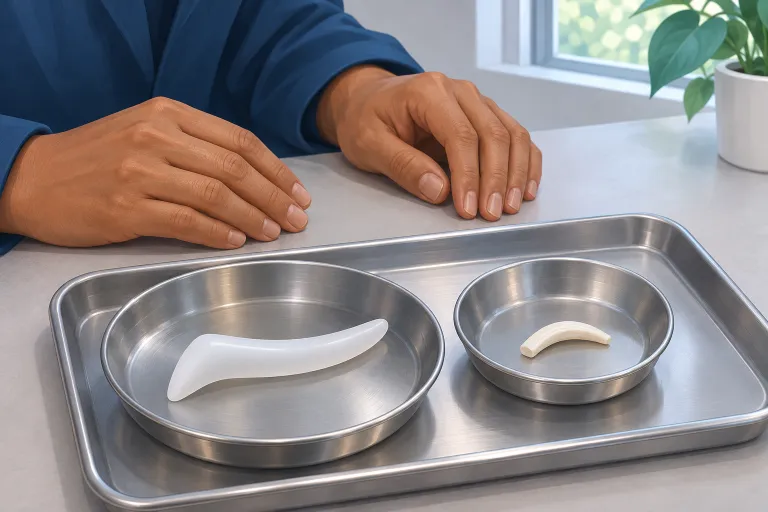
Silicone
Silicone is Yanhee's cheapest implant: 30,000 THB for a standard implant, 40,000 THB for USA grade and 50,000 THB for Korean grade, all day cases.
Yanhee's rib page says "Silicone implants can cause soft-tissue contraction and deformity over time and a higher revision rate", and its implant page says "Over time the skin over an implant can thin, and trauma to the nose can displace it."
One study of 548 Asian patients with custom silicone implants (published 2013) reports "The total complication rate was 6.5% (4.9% deviation, 0.7% extrusion, 0.5% hematoma and 0.3% infection)." Mean follow-up was 6 months, so problems that show up years later may be missed.
Gore-Tex (ePTFE)
Gore-Tex is 70,000 THB as a day case on Yanhee's list.
One study of 1,054 Southeast Asian patients in the Philippines (published 2011) reports "Implant infection occurred in 0.38% of the patients" and "The most common undesirable outcome was implant deviation (1.04%), followed by a visible ePTFE implant (0.47%)."
Wansiri's closed rhinoplasty page says "The implants (silicone or Gore-Tex) are permanent and will never need to be changed or replaced." Yanhee's implant page lists "the possible need for revision surgery" among the risks.
Your own cartilage: septum, ear or rib
Wansiri's open rhinoplasty page lists septal cartilage, "the cartilage wall that separates the nose into two nostrils", ear cartilage and rib, which it calls "stronger than any other cartilage."
At Yanhee, the open-technique combos with ear cartilage run from 105,000 THB (silicone plus ear cartilage) to 202,500 THB (Gore-Tex plus ear cartilage and PCL), all day cases.
Rib is Yanhee's dearest augmentation row, 220,000 THB with one night. Its page says your own cartilage is "highly compatible and carries fewer complications than silicone", though rib "can rarely warp or be reabsorbed".
One study of 83 Asian patients given rib cartilage (published 2012), 39 of them revisions, reports "The complication rate related to grafts was 12 percent, which included five warped grafts and five infections." No patient in it had a collapsed lung (pneumothorax) from the rib harvest.
One meta-analysis of 53 articles (published 2018) found rib cartilage's 14% complication rate "was higher than that of other implants", and noted rib "was more commonly used in revision rhinoplasty". Its authors write: "Our findings were limited by lack of high-quality evidence."
So Yanhee's "fewer complications" line and that analysis point different ways.
Ask the surgeon which material goes in, where any cartilage comes from, and which price row that is.
Making the nose smaller
Wansiri's closed page says "closed rhinoplasty surgery is unable to make the nose smaller", and Vejthani uses open surgery "for major nose reshaping".
Yanhee's Nose Reshaping row is 105,000 THB with two nights. Bangkok Hospital prints "Reduction Rhinoplasty" at 207,000 THB on its English page, and its Thai page prints nose reshaping at 186,000 THB (translated from Thai), each with one night.
Which hospitals and clinics do nose surgery for international patients
Thai law splits the two by overnight stay: a clinic takes no overnight patients and a hospital does, per a Department of Health Service Support manual (translated from Thai). So an operation with a night can't be booked at a clinic.
| Hospital or clinic | City | Surgeons on its nose pages | What the page claims |
|---|---|---|---|
| Yanhee International Hospital | Bangkok | Named, with training lines | "Yanhee is a 400-bed JCI-accredited full hospital." |
| Bangkok Hospital HQ | Bangkok | None named | Its plastic surgery center lists "Augmentation Rhinoplasty, Nose Surgery" |
| Bumrungrad International | Bangkok | None on the treatment page | One price for all nationalities and a free shuttle van from the airport |
| Samitivej | Bangkok | None named for rhinoplasty | Sukhumvit is "a JCI accredited hospital since 2007" |
| Vejthani | Bangkok | Listed through a doctor filter | Open, closed and secondary rhinoplasty |
| Wansiri Hospital | Bangkok | Four with rhinoplasty in their specialty line | Prices on request: "If interested, inquire about service." |
| TRP Hospital | Bangkok | Three, each with a licence number | "a team of professor-level facial plastic surgeons" |
| Rattinan Medical Center | Bangkok | An ear, nose and throat surgeon and a plastic surgeon | Certified by "AACI" of the USA as an outpatient surgery center (translated from Thai) |
Each accreditation line in the table is the hospital's or clinic's own claim. The US International Trade Administration counted 64 JCI-accredited Thai institutions as of June 2025, and a JCI claim covers the named facility only.
Yanhee prints training lines. Dr. Thawatchai Boonpadhanapong's reads "Doctor of Medicine, King Chulalongkorn Memorial Hospital (1984); plastic surgery training, Chulalongkorn Hospital (1998)", plus the "24th Annual Dallas Rhinoplasty Symposium, UT Southwestern Medical Center (2007)".
Yanhee also says "Your surgeon is confirmed at consultation." So get your surgeon's name before you book.
In Phuket, Bangkok Hospital Siriroj says most of its plastic surgery patients are foreigners. Its Phuket Plastic Surgery Institute prints a starting price of 30,000 THB.
How to check a surgeon
The Society of Plastic and Reconstructive Surgeons of Thailand (ThPRS) says there is still no clear written law in Thailand barring doctors without the plastic surgery diploma from cosmetic surgery (patient safety page, translated from Thai). A 2020 Thai law study reached the same conclusion.
Since 3 July 2026, doctors advertising cosmetic services must show their full name and medical licence number (Pattaya Mail). TRP's rhinoplasty page prints "License No. 36825" under Dr. Piyarat Pootragool, so you have a name and a number to check.
For rhinoplasty, review a surgeon's record explains which Thai credentials, consultation details, written terms, aftercare, and revision arrangements warrant review.
Run these checks before you pay a deposit.
Risks the societies list
ASPS lists the risks of rhinoplasty with no percentages. They include "Difficulty breathing", infection, "Possibility of revisional surgery" and "Unsatisfactory nasal appearance".
On the septum it says: "Nasal septal perforation (a hole in the nasal septum) is rare. Additional surgical treatment may be necessary to repair the septum but it may be impossible to correct this complication".
The NHS lists "permanent breathing difficulty", "damage to the cartilage wall between your nostrils", "an altered sense of smell" and "heavy nosebleeds". It also says: "Nose reshaping is a complex operation. The results cannot be guaranteed, there are risks to consider, and it can be expensive."
Symmetry isn't promised either. ASPS says "everyone's face is asymmetric to some degree. Results may not be completely symmetric".
ASPS and the NHS don't print a revision percentage. Vejthani's page says "Around 15% of individuals may require a follow-up (revision) surgery for minor adjustments after the initial procedure."
One study of 177 Asian patients with silicone-ePTFE composite implants (published 2017) reports "an 8.8% revision rate" at 6.0 months of follow-up. One study of 252 revisions after open rhinoplasty (published 2021) found "The revision rate was found to be 10.8 percent."
Revisions carry more infection. One single-surgeon study of 2,630 East Asian rhinoplasties (published 2022) found "Revision surgery had a 19-fold greater infection rate than primary surgery (3.63 percent versus 0.19 percent)."
ASPS's paper on surgery tourism says "Infections are the most common complication seen in patients who go abroad for cosmetic surgery" and that revisions "can be more complicated than the initial operation".
Yanhee prices corrections as separate rows, from 15,500 THB to take an implant out to 271,000 THB for rib cartilage after a previous rib graft, with one night.
Get the revision policy in writing before you pay: who pays for a second operation, and until when.
Recovery and the trip
The splint usually comes off around day 7. The NHS describes "a splint held over your nose with tape for 7 days", and Healthdirect says the splint and bandages come off after about one week.
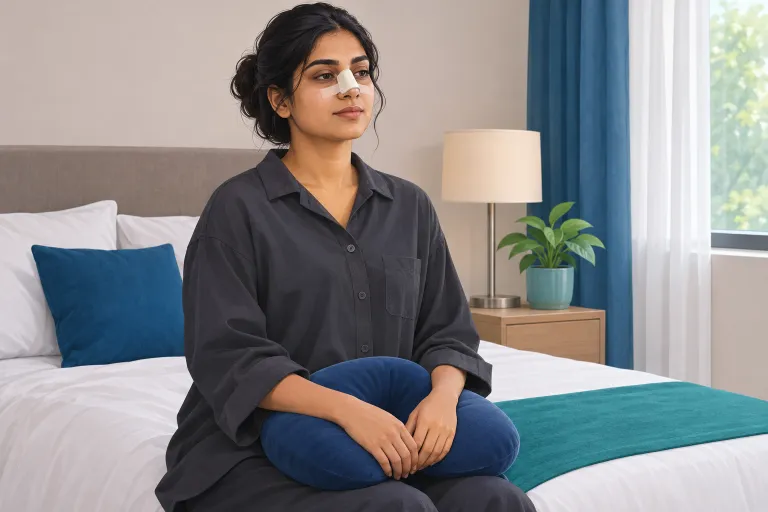
MedlinePlus, the US National Library of Medicine's encyclopedia, says "The splint and cast may be left in place for 1 to 2 weeks." Nasal packing, if used, usually comes out in 3 to 5 days.
Yanhee takes the splint off 5 to 7 days after an implant, Rattinan removes splint and stitches on day 7 depending on the technique (translated from Thai), and Vejthani says "The splint will be worn by you for a week or two."
Hospital nights depend on the operation. Yanhee's silicone and Gore-Tex rows carry none, its rib graft augmentation row one and its Nose Reshaping row two, and Wansiri prints one night for open rhinoplasty and none for closed.
Swelling outlasts the trip. The NHS allows "up to 6 months for the swelling to completely go", and ASPS says "it may take up to a year for your new nasal contour to fully refine."
ASPS names rhinoplasty in its flying advice: wait "seven to 10 days after cosmetic procedures of the face, including facelifts, eyelid surgery, rhinoplasty and laser treatments." The NHS gives 7 to 10 days after facial cosmetic procedures and says "Air travel and major surgery increase your risk of a blood clot, which can be life threatening."
Yanhee's reshaping page says "A follow-up check is usually scheduled within 7 to 10 days." Our planning assumption: 10 nights in Thailand, 14 if your surgeon keeps the splint on for two weeks.
ASPS also says patients "should not sunbathe, drink alcohol, swim/snorkel, water ski/jet ski, parasail, take extensive tours (walking or bus) or exercise after surgery." So book any beach days before the operation.
Thailand's 60-day visa exemption ended on 15 September 2026. The US, UK, Canada, Australia, Ireland and New Zealand are among 60 countries with a 30-day exemption for tourism (country list), and Thailand also issues a medical treatment visa. Ask your Thai embassy whether a surgery trip needs it.
What patients say
The accounts below come from a booking marketplace and one news story. Bookimed's rhinoplasty review page shows 18 reviews rated 4.3 and says "All reviews are 100% real - left by patients who booked through our platform."
One reviewer wrote: "Had a rhinoplasty at B care hospital and the care the team provided was amazing." A German reviewer who had open rhinoplasty wrote in June 2026: "In fact, my breathing is now even better than before."
The complaints are about aftercare. A Singapore reviewer, RITA, wrote in April 2025: "The stitches removal wasnt done thoroughly. I still had abit of stitch left inside, which i removed after coming back."
An anonymous reviewer wrote in May 2025: "Still waiting to see surgeon back in home country as cast taken off to soon and nose is out of shape".
An Austrian reviewer in June 2025 had no complaint about the medical staff but wrote of the booking service: "there was a feeling of being abandoned as soon as payment was made."
Thaiger reported in August 2026 that a Thai influencer says her ear cartilage rhinoplasty at a Bangkok clinic left her nose crooked and her breathing impaired. "Joy stated that her nose tilted to the left immediately after the operation."
The article doesn't name the clinic or the doctor, and the clinic hadn't made a public statement by publication. It says a complaint would also go to the Thai Medical Council.
Before you book, ask who takes the splint and stitches out, and who answers if your nose looks wrong once you're home.
Thailand vs home prices
ASPS puts the average US cost of rhinoplasty at $7,637 and says "it does not include anesthesia, operating room facilities or other related expenses."
The NHS gives £4,000 to £7,000 for the UK and says nose reshaping is "not usually available on the NHS for cosmetic reasons". Healthdirect doesn't print an Australian figure and says "Generally, Medicare doesn't cover the cost of cosmetic surgery."
Yanhee's rib cartilage row at 220,000 THB ($6,639) includes the surgeon, the anesthesia and the night, while the US $7,637 is the surgeon before any of those. Its Gore-Tex row at 70,000 THB ($2,112) is under a third of that fee (our arithmetic).
Flights and hotel come on top. Yanhee's prices don't include either.
In this section: rhinoplasty in Bangkok, rhinoplasty before and after and rhinoplasty clinics in Thailand compared. Related procedures: chin implant surgery in Thailand. This page is part of our cosmetic surgery in Thailand guide, which lists the procedures by area.
Every page about rhinoplasty in Thailand
Published hospital prices, the clinics and surgeons, recovery and the trip home.
What rhinoplasty costs in Thailand
Published hospital prices with what each includes, broker packages and the full trip budget.
- Rhinoplasty Cost in Thailand: Hospital Price Lists (2026)Rhinoplasty in Thailand from the hospitals' own price pages: Yanhee, Bangkok Hospital, PPSI, Rattinan, what each row includes, agency add-ons, trip budget.
Clinics and surgeons
Which hospitals and clinics do nose surgery for international patients, and how to check the surgeon.
- Rhinoplasty in BangkokWhich Bangkok hospitals and clinics print a nose surgery price, where they are and how to check the surgeon.
- Rhinoplasty clinics in Thailand comparedThe Thai hospitals and clinics that do nose surgery, compared on printed prices, accreditation and named surgeons.
Recovery and the trip
How long to stay, when you can fly and what follow-up looks like once you are home.
- Rhinoplasty in Thailand: before and afterWhere Thai clinics show nose surgery before-and-after photos, how to read them and what patients report.
- Rhinoplasty recovery: the timeline and the trip homeWeek by week after nose surgery: splint, swelling, return to work, aftercare, and what Thai hospitals print about stay length and follow-up.
Types and techniques
How the main approaches differ, what each suits and what to ask the surgeon.
- Open vs closed rhinoplasty: how the two approaches differHow open and closed rhinoplasty differ in incision, scar, swelling and what each suits, and what to ask a Thai surgeon about the approach.
- Asian rhinoplasty: implants, cartilage and what to askWhat Asian and augmentation rhinoplasty involve, silicone implants vs your own cartilage, the risks studies report, and what Thai hospitals print.
- Revision rhinoplasty: why noses get redoneWhy a nose gets operated on again, how often studies report it, implant problems, how long to wait, and what Thai hospitals print about revision.
Results and longevity
How long a result lasts, what changes over the years and when a revision is considered.
- Are rhinoplasty results permanent? What changes over timeHow long rhinoplasty results last, when the final shape shows, what can change over the years, implant and cartilage differences and when revision is considered.
Frequently asked questions
Is Thailand good for rhinoplasty?
ASPS lists Thailand among popular destinations for cosmetic surgery tourism and says infections are the most common complication abroad. Choose on the surgeon's board diploma and the hospital's certificate first, then on price. We don't rank hospitals.
How much does a nose job cost in Thailand?
Yanhee's cheapest implant row is 30,000 THB ($905) as a day case, and the dearest nose row on the hospital lists on this page is its 271,000 THB ($8,177) rib cartilage correction with one night. Technique sets the row: implant, own cartilage, reduction or revision. Prices read 27 October 2026.
How long should I stay in Thailand after a nose job?
ASPS says wait seven to 10 days before flying after rhinoplasty. Yanhee removes the splint 5 to 7 days after an implant, and Vejthani says the splint stays on for a week or two. Our planning assumption is 10 nights, 14 if the splint stays on longer.
Is an implant or my own cartilage better?
One 2018 meta-analysis of 53 articles found rib cartilage's complication rate higher than implants', but rib was used more in revisions and the authors call their evidence limited. Yanhee prices standard silicone at 30,000 THB and rib at 220,000 THB. Ask your surgeon which suits your nose.
How do I check a Thai surgeon?
Look the surgeon up by name on the Thai Medical Council's doctor check, ask for the Thai Board of Plastic and Reconstructive Surgery diploma, and search the name on Find A ThPRS Surgeon. Then look up the hospital on the Healthcare Accreditation Institute's certificate search.
Get a Rhinoplasty Quote From Thai Hospitals
Tell us the procedure you are considering, your budget and your dates, and any hospitals you are already looking at.
Get My Free Quote →Free, no obligation. Nothing goes to a clinic without your consent.