Tummy Tuck Belly Button: What Changes in a Full vs. Mini Tuck
A full tummy tuck can change the belly button by bringing it through a new opening after excess skin is removed, as the UK National Health Service (NHS) describes. A mini tummy tuck treats the area below the navel and usually avoids an incision, a surgical cut, around the navel, according to Cleveland Clinic.
If you're considering a tummy tuck in Thailand, ask the surgeon to explain the proposed navel work separately from the lower-abdominal incision. AsiaPatient isn't a hospital, clinic, agency or marketplace and can't determine which operation or navel approach is appropriate for you.
Clinics cannot pay to be listed or ranked higher on AsiaPatient.
Full versus mini tummy tuck: the belly-button difference
A full tummy tuck brings the navel through a new opening. A mini tummy tuck treats below the navel and avoids a navel incision.
The NHS describes the full and partial procedures. ASPS describes the mini incision.
| Procedure | Area treated | Navel work | Scar pattern | Ask the surgeon |
|---|---|---|---|---|
| Full tummy tuck | Can include skin removal in the upper abdomen | Navel released and brought through a new opening | Lower-abdominal scar and a scar around the navel | Where will the new opening and each incision be? |
| Mini tummy tuck | Below the navel | Navel incision avoided, as Cleveland Clinic describes | Shorter lower-abdominal incision in the ASPS description | Is all the planned skin removal below my navel? |
Have the surgeon mark which description matches your plan. If their proposed approach differs, ask them to explain the difference in writing before you decide.
Why a full tummy tuck may create a new belly-button opening
The NHS description of a full tummy tuck includes an incision across the lower abdomen and another to free the belly button from surrounding tissue. The surgeon separates the abdominal skin, removes excess skin and fat, and creates a new opening for the navel.
The American Society of Plastic Surgeons (ASPS) describes pulling the upper abdominal skin downward before trimming the excess. A second incision around the navel may be needed to remove upper-abdominal skin.
Ask the surgeon to show you where the skin will be removed and where the navel opening will sit. Have them distinguish the planned incision from their expectations about its appearance after healing.
The existing navel comes through the new opening
In the ASPS description, the belly button comes through the new skin opening and is stitched into position. The new opening is for the existing navel.
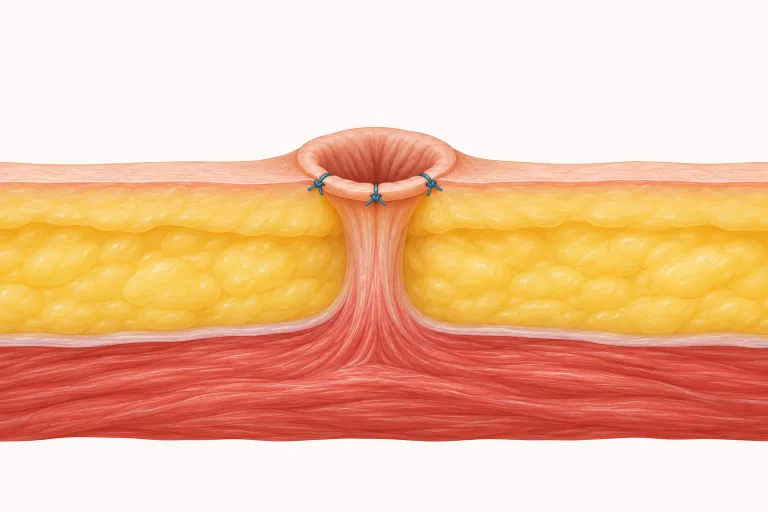
Bangkok Hospital Pattaya describes the operation with this wording: "a second incision is made to separate the skin and navel". Ask the treating surgeon to explain the planned steps on a drawing of your abdomen.
If the consultation uses the word "repositioning," ask what that means in your operation. Ask where the opening and stitches will be, and what the surgeon expects you to see around that area afterward.
A mini tummy tuck usually leaves the navel in place
Cleveland Clinic says the navel incision is avoided in mini abdominoplasty, the medical term for a mini tummy tuck. Its description places the treatment below the belly button.
ASPS says a mini procedure with a shorter incision at pubic-bone level may be recommended when treatment is confined below the navel. That makes the location of the proposed skin removal part of the consultation.
For more on that operation, see mini tummy tuck in Thailand. Ask the surgeon to confirm whether the plan includes any incision around your belly button, even if the proposed operation is called a mini.
The choice is not only about the belly button
Cleveland Clinic describes mini surgery for mild to moderate contour changes when there is little excess skin or abdominal wall weakness. Ask how the amount and location of your skin excess affect the proposed operation.
Bring your concerns about the navel to the same discussion as your concerns about the rest of the abdomen. Ask what each proposed operation would address and what would remain unchanged.
If avoiding an incision around the navel matters to you, say so before agreeing to surgery. Ask whether the proposed operation can address your goals while respecting that preference, and what tradeoffs the surgeon expects.
If muscle separation, called diastasis recti, is part of the discussion
ASPS describes repairing weakened abdominal muscles during a full tuck; for that separate decision, see diastasis recti and tummy tuck surgery.
What scars can include around the belly button
The NHS describes a lower-abdominal scar and, after a full tummy tuck, a scar around the belly button. Ask the surgeon to point out both locations when explaining the operation.
Scar size varies with the procedure. Cleveland Clinic says location also varies and most people retain a visible scar.
Ask what the surgeon expects the navel scar to look like in your case. If you have a preferred appearance, discuss it as a goal and ask what uncertainty remains.
The navel scar is separate from the lower-abdominal scar
Cleveland Clinic places the usual standard tummy-tuck scar across the abdomen, from hip bone to hip bone, just above the pubic area. The navel incision belongs in the discussion too, even when most of the consultation concerns the lower scar.
Ask for a drawing that marks each planned incision.
Have the surgeon label the navel opening and the lower-abdominal incision separately. Ask whether the plan could change during surgery and how that possibility is covered in your consent discussion.
The guide to tummy tuck scars covers general scar care. For the belly button itself, request specific instructions on the incision and the appointments at which the team will assess it.
Belly-button healing and follow-up: questions for your surgeon
No particular belly-button shape can be promised, and these sources give no navel-specific complication rate.
Ask when your surgeon plans to assess the navel's healing and when they expect to discuss its appearance. If you're concerned about the shape, ask how they would assess that concern and when a further review would be appropriate.
ASPS says postoperative instructions may include care of the surgical site, concerns to watch for and follow-up with the surgeon. Ask the team to identify which instructions apply specifically to the navel incision.
Navel-specific risks belong in the consent and safety discussion
ASPS lists poor wound healing, infection, skin loss and unfavorable scarring among tummy-tuck risks. It also lists the possibility of further surgery and an unsatisfactory appearance.
Ask the surgeon which risks apply to the planned navel work and how they would treat them. If they give a percentage, ask whether it describes navel complications specifically or complications from the whole operation.
The wider discussion belongs with tummy tuck risks. For the navel, ask what changes need a prompt call, who will assess them and where that assessment would happen.
What to ask before leaving Thailand
Get the navel follow-up plan in writing before booking.
Use these questions with the treating team:
Ask for the appointment details and contact route alongside the care instructions. If follow-up is proposed remotely, ask who reviews the information you send and what happens if they want an in-person examination.
Keep general activity and travel planning with tummy tuck recovery. Ask the surgeon how the navel check fits into your own departure plan.
Related procedures: fleur-de-lis tummy tuck.
Frequently asked questions
Does a tummy tuck move the belly button?
In a full tuck, the NHS describes freeing the navel and stitching it through a new opening. A mini normally avoids the navel incision, according to Cleveland Clinic.
Does a mini tummy tuck change the belly button?
Cleveland Clinic describes a mini as avoiding the navel incision. Ask your surgeon what they expect to change around your belly button and whether any additional navel work is proposed.
Will there be a scar around my belly button after a tummy tuck?
The NHS describes a scar around the belly button after a full tummy tuck. Cleveland Clinic says scar size and location vary by procedure type; ask the surgeon to mark yours on the plan.
Can a tummy tuck change the shape of my belly button?
ASPS describes bringing the belly button through a new opening and stitching it into position. Ask how the surgeon plans that opening and what appearance they expect, without treating the plan as a shape guarantee.
What should I ask about my belly button before traveling home from Thailand?
Ask who will check the navel before departure, how to contact the surgical team afterward and where an in-person review would happen at home. Get the proposed response to a wound concern or request for further treatment in writing.
Read next
- Seroma after a tummy tuck: what it is, signs and when to contact the surgeonWhat a seroma after a tummy tuck is, what patients may notice, how clinicians may manage it, what studies report, and who to contact after surgery in Thailand.
- What a tummy tuck costs in ThailandEvery published hospital and agency tummy tuck price we found, with what each includes and the date we read it.
- Extended tummy tuck in ThailandWhat an extended tummy tuck involves, who it suits, which Thai hospitals print it and what the recovery looks like.
- Mini tummy tuck: who it suits and how it differsWhat a mini tummy tuck involves compared with a full one, who it suits, recovery and risks, and which Thai hospitals print a mini price.
Ask How a Surgeon Plans the Belly Button in Writing
Tell us the procedure, your budget and your dates, and any hospitals you are considering.
Get My Free Quote →Free, no obligation. Nothing goes to a clinic without your OK.