Diastasis Recti Surgery in Thailand: Repair, Recovery and Questions to Ask
Diastasis recti is an abnormal separation of the two rectus abdominis muscles caused by thinning and widening of the linea alba, according to the European Hernia Society guideline. Surgical repair usually brings the muscles together with stitches, called plication, often during a tummy tuck, as described in a review of surgical techniques.
For wider procedure information, see tummy tuck in Thailand. Ask a surgeon whether repair is appropriate for you and which alternatives deserve consideration.
Clinics cannot pay to be listed or ranked higher on AsiaPatient.
What diastasis recti is, and how clinicians measure it
The European Hernia Society defines rectus diastasis as widening of the linea alba exceeding 2 cm. The linea alba is the connective tissue between the paired abdominal muscles, which BAAPS, the British Association of Aesthetic Plastic Surgeons, describes repairing during abdominoplasty.
The society says clinical examination using finger-width measurement appears adequate for diagnosis. For more precise measurement, it suggests ultrasound or calipers at 3 cm above the navel. European Hernia Society guideline.
A different number appears in the Australian Society of Plastic Surgeons' March 2022 patient funding FAQ: a gap of at least 3 cm. That document describes a proposed Medicare funding descriptor.
Ask which definition your clinician uses, where the gap was measured, and how the measurement affects the treatment discussion.
Non-surgical options come first
The European Hernia Society guideline says physiotherapy may be considered before surgical management. It also says no specific non-operative treatment can be recommended.
In one review of postnatal women, abdominal exercise produced a small reduction in the distance between the muscles compared with usual care.
Ask a physiotherapist which exercises fit your assessment and how progress would be measured. If surgery enters the discussion, the tummy tuck recovery guide covers the separate demands of recovery after an operation.
What the exercise reviews found
These reviews assess different exercise approaches.
- Benjamin and colleagues, 2023: one systematic review and meta-analysis of 16 trials involving 698 postnatal women. The abstract doesn't state the study countries. Six trials with 161 women provided moderate-certainty evidence of a small reduction in muscle separation with abdominal exercise compared with usual care.
- Gluppe and colleagues, 2021: one systematic review with meta-analysis of seven randomized controlled trials involving 381 women. Countries aren't stated in the abstract. It found very low-quality evidence that training the transversus abdominis, a deep abdominal muscle, reduced the distance between the rectus muscles.
- Lyons and colleagues, 2026: one updated systematic review and meta-analysis of 15 studies involving 803 participants. Countries aren't stated in the abstract, and three studies entered the pooled analysis. That analysis found no statistically significant difference in muscle separation between transversus-focused exercise and minimal or no intervention.
- de Oliveira and colleagues, 2025: one systematic review and meta-analysis of 34 randomized clinical trials. The abstract doesn't state the total patient population or countries. It found very low-certainty evidence favoring abdominal exercises over no intervention, and exercises plus other interventions over exercises alone.
Ask what improvement the proposed exercise program aims for and when you'll review it.
When surgery may be considered
The European Hernia Society suggests plication when diastasis occurs without a hernia. When a midline hernia is also present, it suggests mesh-based repair.
That makes the hernia assessment part of the surgical discussion. Ask whether you have a hernia, whether physiotherapy is appropriate first, and what the proposed operation would address.
How plication during a tummy tuck works
Plication brings the midline tissues together with stitches. BAAPS describes repairing the stretched connective tissue between the rectus muscles during abdominoplasty.
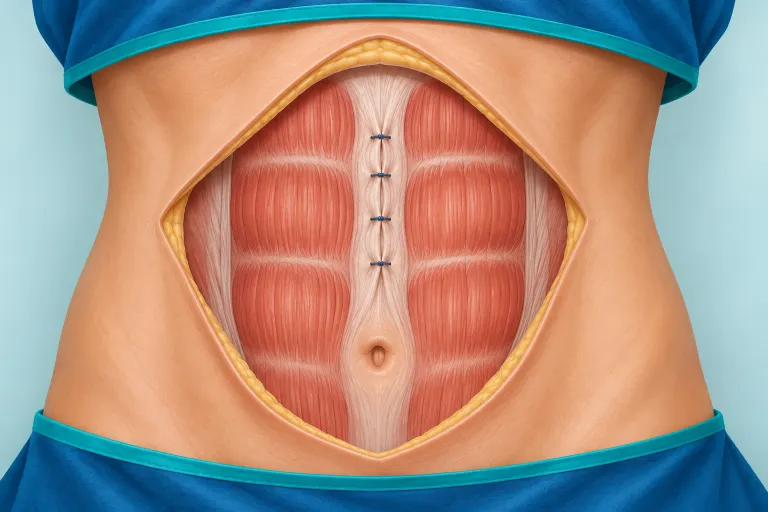
Jessen and colleagues' 2021 scoping review included 61 studies of abdominal rectus-diastasis repair; the abstract doesn't state the countries. All included studies used some form of plication, with technical variations, and classic low abdominoplasty was the most common technique.
The NHS description of a full tummy tuck includes separating the skin from the abdominal wall and realigning the abdominal muscles. It also includes removing excess fat and skin and creating a new opening for the belly button.
Mesh isn't part of every repair described by the European Hernia Society. Its suggestions distinguish plication without a hernia from mesh-based repair when a midline hernia is present.
Ask the surgeon to describe the planned repair in writing. Does it involve plication alone, hernia repair, skin removal, or another procedure?
Recovery, aftercare and flying home from Thailand
Each source below describes its own timing or aftercare guidance.
| Source and context | Hospital stay | Activity or work | Garment or binder | Follow-up or drains |
|---|---|---|---|---|
| NHS, general tummy tuck guidance | Most people need a few nights | About 4 to 6 weeks off work and exercise; about 6 weeks for full recovery | Corset or tummy-control pants usually for 6 weeks | A follow-up appointment will probably be requested after a few weeks |
| Yanhee, its tummy tuck page | Three-night stay in its published offer | "normal activity from about 2 weeks" | Compression garment for "4 to 6 weeks" | "stitch removal at 7 to 10 days"; a temporary drain may be used |
| European Hernia Society, rectus-diastasis guidance | Ask the surgeon about admission | Binders appear to help movement after surgery | Binders appear to reduce postoperative pain and psychological stress | The guideline reports no effect on seroma formation or lung function |
The NHS travel guidance recommends no flying for 7 to 10 days after a tummy tuck. It says air travel and major surgery increase blood-clot risk.
Yanhee says to expect flight clearance after its stitch-removal follow-up, with the surgeon clearing the patient for the specific flight length. Ask for your own clearance and travel plan before fixing a return date.
The NHS also advises asking where follow-up will happen and what arrangements apply if complications or further surgery occur. Ask who will assess a concern after you return home and how any further care would be arranged.
Risks, recurrence and what the studies actually report
The American Society of Plastic Surgeons (ASPS) lists bleeding, infection, fluid accumulation, poor wound healing, altered sensation and persistent pain among tummy-tuck risks. Its list also includes anesthesia risks, unfavorable scarring, further surgery, and deep vein thrombosis, cardiac and pulmonary complications.
Ask the surgeon which risks matter for your medical history and planned operation.
Diastasis-repair review
Van Kerckhoven and colleagues, 2021, is one systematic review of 24 selected articles covering 931 surgically treated patients aged 18 to 70. The abstract doesn't state the countries.
The review reported recurrence in 5% of patients. It also reported seroma, a fluid collection, in 7%; abdominal hypoesthesia, reduced sensation, in 6%; surgical-site infection in 2%; and chronic pain in 4%. Review abstract.
Follow-up ranged from 3 weeks to 20 years in that review. Review abstract.
A small 2026 technique study
Descarrega and colleagues, 2026, is one prospective, self-controlled ultrasound case series of 16 consecutive patients after bariatric surgery, which is weight-loss surgery. It also included surgery on three cadaver specimens; the authors' affiliations are in Spain, but the abstract doesn't state the patient population's country.
The study measured transverse plication and reported average reductions in muscle separation of 0.6 cm and 0.7 cm at two defined measurement points. Study abstract.
Insurance and public funding
Funding rules need a separate answer. The UK National Health Service (NHS) regards abdominoplasty as cosmetic surgery and says it isn't usually available on the NHS.
In Australia, healthdirect says Medicare doesn't cover cosmetic surgery, and private health insurance often doesn't either. It says part of the cost may be covered when a tummy tuck is performed for reconstructive reasons.
A 2022 Medicare Benefits Schedule factsheet described a narrow pregnancy-related route for radical abdominoplasty with rectus-diastasis repair. Ask the funding body which current criteria apply to your proposed operation and whether treatment abroad is covered.
What Thai hospitals print about muscle repair
Yanhee International Hospital says its full tummy tuck treats above and below the navel, "repairs muscle separation" and moves the navel. Ask whether the operation proposed for you includes that repair.
Yanhee prints THB 126,000 for a tummy tuck at body weight under 70 kg, including a three-night hospital stay, read 3 November 2026. Its published terms cover the surgeon, anesthesia and stated stay, with flights and accommodation excluded. Yanhee's tummy tuck page.
The hospital also lists a weight-based supplement above that threshold. Ask how it applies to your quote and whether any other procedures are included. Yanhee's published terms.
This is the hospital's tummy-tuck offer. For broader cost information, see tummy tuck cost in Thailand.
Questions to ask the surgeon before traveling
Ask for the diagnosis, proposed repair and aftercare plan in writing.
The measurement and hernia questions follow the European Hernia Society guideline. The aftercare questions follow NHS guidance on surgery abroad.
Frequently asked questions
What is diastasis recti?
The European Hernia Society describes abnormal separation of the two rectus abdominis muscles caused by thinning and widening of the linea alba. Its definition uses widening exceeding 2 cm.
How is diastasis recti measured?
The European Hernia Society says clinical examination with finger-width measurement appears adequate for diagnosis. It suggests ultrasound or calipers at 3 cm above the navel for greater precision.
Can diastasis recti improve without surgery?
Reviews disagree. One systematic review in postnatal women found moderate-certainty evidence of a small reduction with abdominal exercise, while a 2026 update found no statistically significant difference for transversus-focused exercise compared with minimal or no intervention. Ask a physiotherapist what an exercise program could reasonably aim to change in your case.
Is diastasis recti repair done during a tummy tuck?
It can be. The 2021 scoping review found some form of plication in every included study, and classic low abdominoplasty was the most common technique.
How long is recovery after tummy tuck surgery with muscle repair?
The NHS advises about 4 to 6 weeks off work and exercise after a tummy tuck. Ask your surgeon how the planned muscle repair affects your activity and follow-up instructions.
Does insurance or the NHS pay for diastasis recti surgery?
The NHS says abdominoplasty isn't usually available through the NHS. Australia's healthdirect says part of the cost may be covered for reconstructive tummy tuck, while cosmetic surgery isn't covered by Medicare and often isn't covered by private insurance.
Ask your insurer or funding body for a written decision covering the proposed operation and country of treatment.
Read next
- Tummy tuck in BangkokWhich Bangkok hospitals print a tummy tuck price, where they are and what the stay looks like.
- Tummy tuck recovery: drains, blood clots and flying homeWeek by week after a tummy tuck: drains, walking bent, binder, return to work, the clot and seroma risks, and what Thai hospitals print about stay.
- What a tummy tuck costs in ThailandEvery published hospital and agency tummy tuck price we found, with what each includes and the date we read it.
- Extended tummy tuck in ThailandWhat an extended tummy tuck involves, who it suits, which Thai hospitals print it and what the recovery looks like.
Ask a Thai Surgeon About Diastasis Repair in Writing
Tell us the procedure, your budget and your dates, and any hospitals you are considering.
Get My Free Quote →Free, no obligation. Nothing goes to a clinic without your OK.