How Many Grafts Do I Need for a Hair Transplant?
Part of our comprehensive hair transplant guide, this page helps you understand graft requirements for your Norwood level. "How many grafts do I need?" is the first question most patients ask. The answer depends on multiple factors: how much hair you've lost, how dense you want the result, your hair characteristics, and your donor supply. This guide walks you through the calculation process so you understand what surgeons base their estimates on.
Understanding Grafts vs. Hairs
Critical distinction:
- 1 graft (follicular unit) = 1-4 individual hair strands
- Average graft contains 2-2.5 hairs
Why it matters:
Some clinics advertise "5,000 hairs transplanted!" when they actually placed 2,000 grafts. Grafts are the standard unit. Always ask for graft count, not hair count.
Typical distribution in extracted grafts:
- 20% single-hair grafts (for hairline refinement)
- 40% double-hair grafts (most common)
- 30% triple-hair grafts (mid-scalp density)
- 10% quadruple-hair grafts (crown coverage)
A 2,500-graft procedure actually transplants ~5,500-6,000 individual hairs.
The Norwood Scale: Mapping Your Hair Loss
The Norwood-Hamilton Scale classifies male pattern baldness from 1 (no loss) to 7 (extensive baldness).
Norwood 1: No Hair Loss
- Full head of hair
- No transplant needed
Norwood 2: Minimal Recession
- Slight recession at temples
- Mature hairline forming
- Typical grafts needed: 500-1,000
- Focus: Temple points restoration
Norwood 3: Moderate Recession
- Deeper temple recession
- M-shaped hairline
- Typical grafts needed: 1,500-2,000
- Focus: Hairline restoration, frontal zone
Norwood 3 Vertex: Same as NW3 but with thinning crown spot
- Typical grafts needed: 2,000-2,500 (hairline + crown)
Norwood 4: Significant Loss
- More extensive frontal recession
- Bridge of hair between front and crown
- Typical grafts needed: 2,500-3,000
- Focus: Frontal zone, may need 2nd session for crown later
Norwood 5: Extensive Loss
- Bridge between front and crown thinning
- Horseshoe pattern emerging
- Typical grafts needed: 3,000-4,000
- Strategy: Often split into 2 sessions (front first, crown 8-12 months later)
Norwood 6: Advanced Loss
- Bridge gone, only sides and back remain
- Large bald area
- Typical grafts needed: 4,000-5,500
- Sessions: 2-3 procedures
- Reality check: May not achieve full density. Prioritize hairline and frontal-mid coverage
Norwood 7: Maximum Loss
- Only horseshoe pattern remains (sides and back)
- Largest transplantable area
- Typical grafts needed: 5,000-7,000+
- Sessions: 2-3 procedures minimum
- Realistic goal: Frame the face with hairline, sparse coverage in mid-scalp, crown often left thin
Women: Use Ludwig Scale (I-III) or Female Pattern Hair Loss (FPHL) classifications. Women typically need 1,000-2,500 grafts for diffuse thinning or hairline reconstruction.
Calculating Grafts: The Formula Approach
Basic formula:
Grafts needed = (Area to cover in cm²) × (Desired density in FU/cm²)
Step 1: Measure Area
Typical areas:
- Hairline to mid-scalp: 50-80 cm²
- Crown: 80-120 cm²
- Full top (hairline to crown): 130-200 cm²
Your surgeon measures using calipers or digital mapping.
Step 2: Choose Density Target
Natural density (non-balding scalp): 60-100 FU/cm²
Transplant density targets:
- Conservative (natural-looking): 30-35 FU/cm²
- Standard: 35-40 FU/cm²
- Aggressive (maximum density): 40-50 FU/cm²
Why not match natural density?
- Donor supply is limited (can't extract 100% of donor hair)
- Graft survival isn't 100% (90-95% typical)
- Scalp can't support infinite density (blood supply limits)
The good news: 35-40 FU/cm² looks completely natural. The eye doesn't detect the difference from 60+ FU/cm².
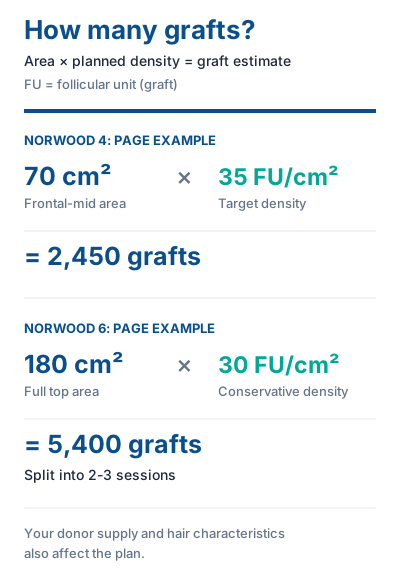
Step 3: Calculate
Example: Norwood 4 patient
- Frontal-mid area: 70 cm²
- Target density: 35 FU/cm²
- Grafts needed: 70 × 35 = 2,450 grafts
Example: Norwood 6 patient
- Full top area: 180 cm²
- Target density: 30 FU/cm² (conservative due to large area)
- Grafts needed: 180 × 30 = 5,400 grafts
- Reality: Split into 2-3 sessions
Graft Requirements by Zone
Surgeons often break down transplants by specific zones:
Hairline and Frontal Third
- Area: 40-60 cm²
- Grafts: 1,200-2,000
- Priority: Single-hair grafts at very front (soft, natural edge)
- Density target: 40-50 FU/cm² (most visible area)
Mid-Scalp
- Area: 50-80 cm²
- Grafts: 1,500-2,400
- Priority: 2-3 hair grafts (balance between coverage and supply)
- Density target: 35-40 FU/cm²
Crown (Vertex)
- Area: 80-120 cm²
- Grafts: 1,500-3,000
- Priority: Often deferred to 2nd session (requires many grafts, less visible)
- Density target: 30-35 FU/cm² (whorl pattern requires careful planning)
Strategic approach for limited donor:
If you have 4,000 usable grafts but need 6,000 for full coverage:
- Session 1: Hairline + frontal-mid (3,000 grafts): frame the face
- Wait 12-18 months: See how well grafts grew, how much native hair remains
- Session 2: Fill mid-scalp + crown with remaining grafts OR decide the hairline was enough
Never sacrifice hairline quality for crown coverage. Hairline defines your appearance.
Factors That Affect Graft Numbers
1. Hair Caliber (Thickness)
Thick, coarse hair:
- Provides more visual coverage per graft
- Can achieve natural look with 30-35 FU/cm²
- Each hair casts more shadow, creates illusion of density
Fine, thin hair:
- Requires more grafts for same visual effect
- Target 40-50 FU/cm² for satisfying coverage
- More grafts needed overall
Rule of thumb: Fine-haired patients need 15-25% more grafts than coarse-haired patients for equivalent visual result.
2. Hair Color and Contrast
Low contrast (blonde hair, light skin OR dark hair, dark skin):
- Scalp less visible between hairs
- Can achieve natural look with fewer grafts
- 30-35 FU/cm² often sufficient
High contrast (dark hair, light skin):
- Scalp very visible between hairs
- Requires higher density (40-50 FU/cm²)
- May need 20-30% more grafts for same coverage
Gray/white hair:
- Lowest contrast
- Easiest to achieve dense appearance
- Lowest graft requirements
3. Hair Curl
Straight hair:
- Lays flat against scalp
- Requires more grafts for coverage
- Scalp visibility higher
Wavy/curly hair:
- Adds volume and texture
- Better coverage per graft
- Can use 15-20% fewer grafts
Afro-textured hair:
- Maximum coverage per graft
- Best "bang for buck" in transplants
- Can achieve great results with moderate graft counts
4. Donor Density
Your donor area determines maximum grafts available.
Measuring donor density:
- Average: 60-80 FU/cm²
- Above average: 80-100 FU/cm²
- Exceptional: 100+ FU/cm²
Safe extraction limits:
- FUE: Max 25-30% of follicles from any zone
- FUT: Depends on scalp laxity (strip width)
Typical total donor capacity:
- Low: 4,000-5,000 grafts (lifetime)
- Average: 5,000-7,000 grafts
- High: 7,000-10,000 grafts
Example calculation:
Donor area: 200 cm² Donor density: 70 FU/cm² Total follicles: 14,000 FU Safe extraction (25%): 3,500 grafts in one session Lifetime potential (50%): 7,000 grafts over 2-3 procedures
Conservative surgeons leave safety margin for potential future procedures.
Graft Distribution Strategy
Single-Hair Grafts (20% of total)
- Placement: Hairline (first 5-8mm)
- Purpose: Create soft, undetectable transition
- Why: Single hairs at edge look natural; multi-hair grafts create "pluggy" look
Double-Hair Grafts (40% of total)
- Placement: Behind hairline (next 1-2cm)
- Purpose: Build density while maintaining natural appearance
Triple-Hair Grafts (30% of total)
- Placement: Mid-scalp, density zones
- Purpose: Maximize coverage with available grafts
Quadruple-Hair Grafts (10% of total)
- Placement: Crown center, areas needing maximum density
- Purpose: Get most visual impact from limited grafts
Poor technique: Using triple/quad grafts at hairline (creates "corn row" or "doll hair" look)
Common Mistakes in Graft Calculation
Mistake 1: Overpromising Grafts
Red flag: Surgeon promises "5,000 grafts no problem" without measuring donor
Reality: Most donors yield 3,000-4,000 grafts safely in one FUE session
Risk: Overharvesting causes visible donor depletion, "moth-eaten" appearance
Mistake 2: Under-Estimating Needs
Problem: Trying to cover Norwood 5 with 2,000 grafts
Result: Thin, sparse coverage everywhere; looks unnatural
Better: Concentrated density in smaller area (hairline + frontal third)
Mistake 3: Ignoring Hair Characteristics
Mistake: Using "average" graft counts without considering fine vs. coarse hair
Better: Adjust estimates based on hair caliber, color, curl
Mistake 4: Not Planning for Future Loss
Problem: Using all donor grafts in one procedure
Risk: If hair loss progresses, no grafts left for revision
Better: Leave 20-30% donor capacity for potential future needs
Creating Realistic Expectations
The honest truth surgeons should tell you:
Norwood 6-7 patients cannot achieve teenage density.
Your donor supply isn't infinite. Even with 6,000+ grafts, you're redistributing hair from back to top. You don't have more total hair.
What IS achievable:
- Natural-looking hairline that frames your face
- Satisfying density in frontal-mid zones (where most visible)
- Sparse-to-moderate crown coverage
What is NOT achievable (in most cases):
- Full, thick coverage across entire scalp
- NW1 hairline density if you're NW6
- Covering massive areas with limited donor
Good surgeons are conservative. They'd rather under-promise and over-deliver.
Session Planning for High Graft Needs
If you need 5,000+ grafts, expect multiple sessions.
Typical approach:
Session 1 (2,500-3,500 grafts):
- Hairline + frontal-mid zone
- Goal: Frame the face, create natural appearance
- Wait 12-18 months for full growth
Session 2 (2,000-3,000 grafts):
- Add density to mid-scalp
- Address crown if grafts available
- Refine hairline if needed
Session 3 (optional, 1,500-2,500 grafts):
- Further density refinement
- Crown completion
- Touch-up areas that didn't grow well
Spacing between sessions: Minimum 8-12 months (lets you see full result, allows donor area recovery)
Questions to Ask Your Surgeon
- How many grafts do you estimate I need?
- How did you arrive at that number? (Should explain area × density calculation)
- What's my donor density? (Should measure, not guess)
- How many grafts can my donor safely provide?
- Are we doing all at once or splitting into sessions?
- What density are you targeting? (FU/cm²)
- What percentage of my donor area will you extract from?
- Will I have enough left for potential future procedures?
Red flags:
- Refuses to explain calculation
- Promises "unlimited grafts"
- Hasn't measured donor area
- Dismisses your questions with "trust me, I'm the expert"
Conclusion
Graft calculation isn't arbitrary. It's based on measurable factors: area to cover, target density, donor supply, and hair characteristics. Most patients need:
- Norwood 2-3: 1,500-2,000 grafts
- Norwood 4: 2,500-3,000 grafts
- Norwood 5: 3,000-4,000 grafts (possibly 2 sessions)
- Norwood 6-7: 4,500-6,000+ grafts (definitely multiple sessions)
The right number balances your goals with your donor supply while leaving safety margin for future needs.
Next steps:
- Understand realistic outcomes: Hair Transplant Success Rate Guide
- Return to complete guide: Hair Transplant Guide
- Learn about costs based on graft numbers