Upper Eyelid Surgery in Thailand: Assessment, Recovery and Planning
Upper eyelid surgery, also called upper blepharoplasty, can remove excess skin from the upper lid and address fat, as described by the American Academy of Ophthalmology (AAO) EyeWiki.
Before comparing a proposed operation or planning travel, ask the surgeon what is causing your upper-lid heaviness. The eyelid surgery in Thailand guide covers the broader discussion.
AsiaPatient isn't a hospital, clinic, agency or marketplace, and doesn't set treatment plans or seller prices.
Clinics cannot pay to be listed or ranked higher on AsiaPatient.
What upper eyelid surgery can address, and what it can't
Excess upper-lid skin and fat
The AAO's EyeWiki lists loose or excess upper-lid skin, protruding fat and excess tissue causing visual symptoms or cosmetic concerns among the reasons for upper blepharoplasty. The medical term for excess or lax eyelid skin is dermatochalasis.
Cleveland Clinic describes blepharoplasty as removing or repositioning extra skin, fat and muscle tissue around the eyes. Ask which tissue your surgeon proposes to treat and what change that is intended to make.
Ptosis, brow descent, and double-eyelid surgery are separate questions
EyeWiki defines eyelid ptosis as an unusually low upper-lid edge when looking straight ahead. It distinguishes that finding from excess skin and a low brow because their surgical management differs.
If the consultation raises that finding, the ptosis surgery guide covers the separate discussion. Ask whether the proposed operation includes ptosis treatment, rather than assuming it from the words "eyelid lift."
Yanhee Hospital describes double-eyelid creation as forming an upper-eyelid crease for someone with a monolid who wants a defined crease. For a brief comparison of the procedure labels, use the eyelid surgery types guide.
What an upper eyelid lift doesn't do
MedlinePlus states that eyelid surgery doesn't lift sagging eyebrows. Cleveland Clinic likewise says blepharoplasty alone can't reposition an eyebrow.
Ask the surgeon to explain the role of brow position in your assessment. Keep that explanation beside the proposed upper-lid treatment when reviewing the plan.
Find the cause of hooding before choosing surgery
The clinician's assessment of skin, fat, lid position, and brow position
The AAO's EyeWiki includes dry-eye history, medicines and supplements, and tobacco and alcohol use in the assessment. Its examination covers ptosis, brow position, eyelid closure, the tear film on the eye's surface, vision and visual fields.
These are points to discuss at an examination. Ask the clinician to explain the findings, rather than trying to decide which operation you need from a mirror or photograph.
StatPearls lists dry eyes, thyroid disease, protruding eyes and clotting disorders as relative contraindications to upper blepharoplasty. These are conditions that can weigh against surgery; ask how your medical and eye history affects the assessment.
Functional symptoms and cosmetic goals need separate documentation
It describes patients raising their brows or chin to see, and lists difficulty driving or seeing traffic lights among functional concerns.
The AAO's EyeWiki includes visual-field assessment as well as cosmetic concerns. Tell the surgeon what affects your daily activities and, separately, what you would like to change about your appearance.
Ask which findings support a functional concern and which relate to appearance. If seeking insurance reimbursement, ask your insurer what documentation it requires for the proposed treatment.
When ptosis or a low brow changes the discussion
StatPearls describes outer-lid hooding that combines a descended outer brow with excess eyelid skin. More than one finding might be involved.
The AAO's EyeWiki says patients with significant brow descent may need concurrent brow lifting. Its brow assessment page describes the clinician distinguishing brow-related hooding from excess lid skin.
Ask why any additional treatment is being discussed and whether it changes the consent form, recovery instructions or quote. This is a consultation question, not a reason to assume combined surgery is necessary.
What upper blepharoplasty may involve
Incision, skin treatment, and fat treatment
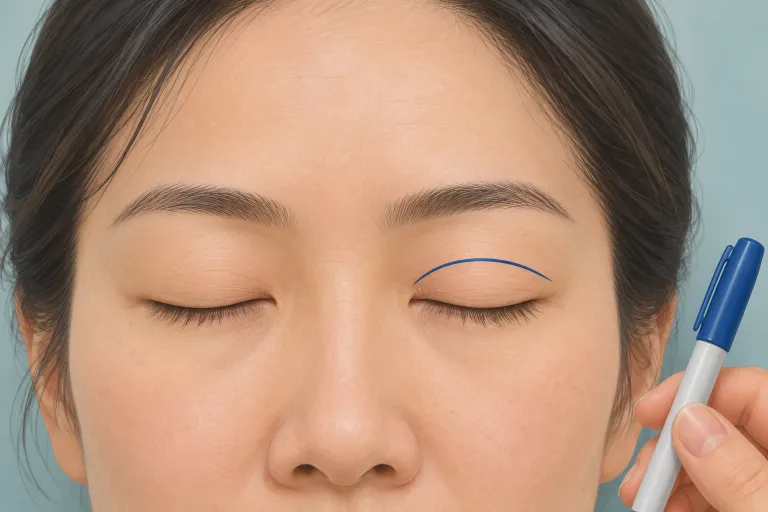
The UK National Health Service (NHS) says upper-eyelid surgery generally involves an incision made along the natural skin fold. The surgeon removes excess skin, fat or muscle, then closes the incision.
The AAO's EyeWiki describes removing skin with or without muscle and conservatively shaping or removing excess fat if warranted. Its steps include suturing the incision.
Ask the surgeon to mark the intended incision and explain what your upper blepharoplasty would remove or preserve. If the plan includes treatment for ptosis, ask for that part of the operation to be explained separately.
Anatomy and double-eyelid discussion
StatPearls describes a lower attachment of the orbital septum, a layer of tissue inside the eyelid, in Asian eyelids, associated with a lower skin crease. Ask the surgeon to explain this tissue attachment in relation to your own eyelid anatomy and goals.
For crease-creation questions, see double-eyelid surgery in Thailand. Ask whether creating or changing a crease is part of the proposal, and how that differs from removing excess skin.
Risks and reasons to contact the treating team
Risks to discuss before surgery
The AAO's upper-blepharoplasty guidance lists bleeding, infection, poor healing, scarring and asymmetry. It also lists overcorrection, undercorrection, difficulty closing the eyelids, dry eye and anesthesia risks.
The same AAO guidance includes bleeding behind the eye and the rare risk of vision loss. Ask how the surgeon assesses these risks in your case and what treatment would be arranged if a complication occurs.
MedlinePlus also lists double or blurred vision, slow or uneven healing, and eyelids that don't match. Ask which risks relate to the upper-lid operation and which relate to any other planned treatment.
Who will give postoperative advice and urgent contact details
Ask for the treating team's postoperative contact instructions in writing.
Who answers outside clinic hours? Which changes need urgent assessment, and where should you go if the surgeon can't be reached?
Ask which surgeons or other team members would examine you if a concern develops after you leave Thailand. Request contact details and the agreed follow-up arrangements before traveling.
Upper eyelid surgery recovery and aftercare
Recovery milestones differ by activity. Use them to prepare questions for your surgeon about work, exercise and appointments.
| Source | Early aftercare | Activity or work milestone | Follow-up or stitches | What may take longer |
|---|---|---|---|---|
| AAO EyeWiki, upper blepharoplasty | Ice for the first 3 days, then warm compresses | Avoid lifting, bending, straining and exercise for the first 10 days | Follow-up within 1 to 2 weeks | Ask about your healing progress at review |
| NHS, eyelid surgery | May need head elevation, prescribed drops or ointment, and cold packs | Most people take about 2 weeks off work | Ask for your appointment and stitch plan | Bruises and redness may take several weeks; scars may feel tight for a few months |
| MedlinePlus, eyelid lift | No contact lenses for at least 2 weeks | Minimal activity for 3 to 5 days; avoid strenuous activity for about 3 weeks | Stitches removed after 5 to 7 days if removal is needed | Bruising may last 2 to 4 weeks; scars may remain pink for 6 months or more |
Early aftercare and follow-up are source-specific
The AAO's EyeWiki also describes prescribed antibiotic ointment and lubricants as needed. Ask your surgeon for the names, application instructions and duration of any medicines prescribed for you.
The NHS says patients may need sunglasses and cold packs during recovery. It advises avoiding contact lenses and eye rubbing, and strenuous activity and swimming for a few days.

Ask for instructions that cover the whole proposed operation, including any additional procedure. Request a written answer on when to restart your usual activities.
Why the milestones shouldn't become one deadline
The NHS discusses time off work, while MedlinePlus gives separate activity, stitch-removal and visible-healing milestones. Minimal activity and returning to work are different measures.
Ask the treating team to put your review dates beside your work and activity restrictions. The eyelid surgery recovery guide covers the wider aftercare discussion.
Planning upper eyelid surgery in Thailand
A local stay and follow-up plan need to match the hospital's instructions
Yanhee International Hospital in Bangkok describes its eyelid operation as "a day case with no overnight stay." Ask the hospital separately how long you should remain nearby and when it wants to see you again.
Request dates for the first review and any stitch removal. Ask who will decide when your planned departure is appropriate, and what happens if another examination is needed.
A published price needs its operation and scope
Yanhee's public eyelid-surgery page, read 4 November 2026, lists upper blepharoplasty from THB 33,500 as a day case under local anesthesia with sedation. Ask for the exact procedure and inclusions in your own quote; the eyelid surgery cost page covers the broader price context.
What to confirm in writing before travel
Request the surgeon's proposed procedure and the hospital's booking terms together. Ask for the anesthesia plan, local appointment schedule, included services, exclusions and quote validity.
Ask whether tests, medicines, stitch removal and later reviews are included. Request separate answers about hospital admission, accommodation and transport, and how additional care would be charged if needed.
Bangkok planning is hospital-specific
For city-level planning, see eyelid surgery in Bangkok. Ask your chosen hospital to confirm where the consultation, operation and follow-up appointments will take place before arranging accommodation.
Questions to take to an upper-eyelid consultation
Use these questions to get the surgeon's findings and proposed scope in writing:
In this section: lower eyelid surgery. Related procedures: brow lift vs eyelid surgery.
Frequently asked questions
What is upper eyelid surgery?
Upper blepharoplasty is surgery on the upper eyelid. The NHS describes an incision in the natural fold, removal of excess skin, fat or muscle, and closure of the incision.
Can upper eyelid surgery help with hooded eyes?
StatPearls describes hooding that involves both excess lid skin and a low outer brow. It says assessment determines whether lid surgery alone can address that hooding or whether brow repositioning needs consideration.
Ask the surgeon which finding explains your concern and what the proposed operation would address.
Is upper eyelid surgery the same as ptosis repair?
The terms describe different parts of treatment. MedlinePlus distinguishes removing loose skin and fat from tightening the eyelid tendon when ptosis repair is also performed.
Ask whether your proposed surgery includes either or both, and have each part listed on the plan.
Can upper eyelid surgery lift the eyebrows?
No. Cleveland Clinic states that blepharoplasty alone can't reposition the eyebrow.
How long does upper eyelid surgery recovery take?
The NHS says most people take about 2 weeks off work. MedlinePlus advises minimal activity for 3 to 5 days and avoiding strenuous activity for about 3 weeks.
Ask the treating team for your schedule, including appointments and restrictions for your job.
What should I ask about a Thailand upper-eyelid surgery quote?
Ask for the operation's full name, the tissue or lid-position treatment proposed, and the anesthesia plan. Request the local stay and follow-up schedule, inclusions, exclusions, quote validity and postoperative contact arrangements in writing.
If another procedure is proposed, ask for its scope and care instructions separately.
Read next
- What eyelid surgery costs in ThailandEvery published hospital and agency eyelid surgery price we found, with what each includes and the date we read it.
- Eyelid surgery in BangkokBangkok hospitals and clinics that print an eyelid surgery price, with what each includes.
- Blepharoplasty recovery: timeline and the trip homeDay by day after eyelid surgery: swelling, stitches out, screens, contact lenses, return to work, warning signs, and what Thai hospitals print about stay.
- Eyelid surgery scars: incision lines and healingWhere upper and lower eyelid incisions sit, why a scar can look visible and tight for a few months, and when to contact the surgeon.
Ask a Surgeon What Is Causing Your Upper Lid Heaviness
Tell us the procedure, your budget and your dates, and any hospitals you are considering.
Get My Free Quote →Free, no obligation. Nothing goes to a clinic without your OK.