Blepharoplasty Recovery: What to Expect in Thailand (2026)
Blepharoplasty is eyelid surgery, and recovery has several stages: the UK National Health Service (NHS) says most people take about two weeks off work. Bruising and redness may take several weeks to fade, while scars may feel tight for a few months.
For eyelid surgery in Thailand, ask which operation your recovery instructions cover. The NHS describes upper-lid surgery and lower-lid operations with an incision below the lashes or inside the lid.
Double-eyelid surgery creates an upper-lid crease, as Yanhee Hospital describes it. Ask whether your plan includes crease creation, removal of skin or fat, or another procedure, and which aftercare schedule applies.
Clinics cannot pay to be listed or ranked higher on AsiaPatient.
What the first days can look like
The NHS lists temporary puffy or numb lids, irritated or watery eyes, bruising and scars among expected effects. It lists blurred or double vision among possible complications.
Bumrungrad's eyelid, lacrimal and orbital surgery instructions cover surgery involving the eyelids, tear system and eye socket. The hospital says swelling and black-and-blue discoloration may be more evident two or three days after surgery.
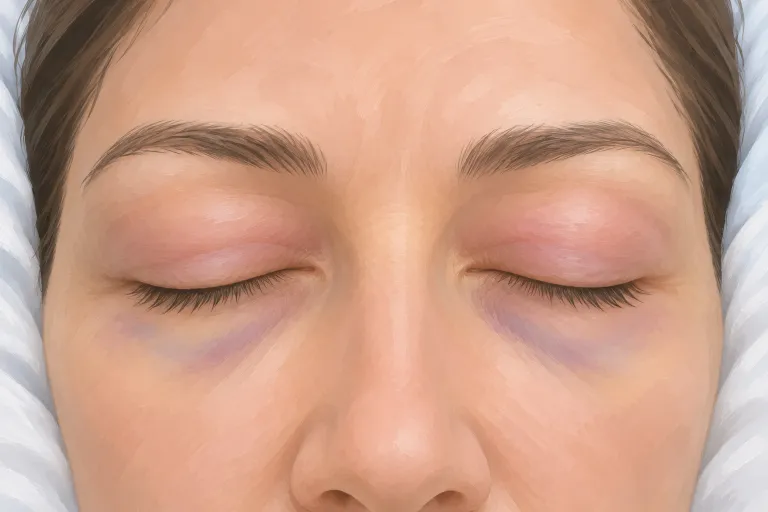
The same Bumrungrad page lists excessive tearing, light sensitivity, itchiness, blood-red tears and taut eyelids as symptoms it expects to improve daily. Increased blurred vision is on its list of reasons to seek medical advice.
Symptoms might take time to settle, as the NHS explains. So ask your surgeon what changes to expect and which symptoms need a call before your next appointment.
Blepharoplasty recovery timeline: what the sources say
Use these milestones to discuss your schedule with the surgeon; the NHS says to follow the surgeon's recovery advice.
The American Academy of Facial Plastic and Reconstructive Surgery (AAFPRS) gives a schedule for permanent stitches.
| Stage | What the source says |
|---|---|
| Early aftercare | AAFPRS describes cold compresses, head elevation and eye drops where recommended. |
| Stitch removal | Bangkok Hospital Pattaya says two days to one week. AAFPRS says permanent stitches come out in three to five days. Wansiri Hospital lists five to seven days for double-eyelid surgery. |
| Activity and work | Bangkok Hospital Pattaya says daily activities can resume after 10 days. The NHS says most people take about two weeks off work. |
| Swelling and bruising | Bumrungrad's drooping-eyelid page says swelling improves after stitch removal and returns to normal within one to two months. |
| Later appearance | The NHS says scars may remain visible and tight for a few months. Yanhee says the final result develops over six to 12 months. |
Ask about your job, contact lenses and exercise separately, rather than asking only when you'll be recovered.
Aftercare instructions to discuss with your surgeon
The NHS describes head elevation for a couple of days, cold packs and prescribed ointment or eye drops. Its advice also includes sunglasses and avoiding eye rubbing and contact lenses.

AAFPRS says patients clean the eye area for a week and a half. Ask the team to explain the cleaning method and demonstrate it before you leave.
Bumrungrad says stitches can be cleaned twice daily and an ice pack may be used for the first 72 hours, with warm moist compresses after that. Its page distinguishes stitches removed at the hospital from absorbable stitches, which dissolve or fall out.
For double-eyelid surgery, Wansiri describes cold compresses and head elevation for the first 48 hours, saline cleaning and medicine as directed. Ask your treating team which instructions fit your operation.
Bumrungrad's drooping-eyelid page says to avoid getting the wound wet, and to limit eye strain as much as possible for the first one to two weeks. Ask what that means for reading, screen work and your usual routine.
Activity instructions differ. Bumrungrad says to avoid stooping, bending and straining during the first week, and vigorous exercise for two weeks.
Wansiri says to avoid heavy exercise or movements affecting the wound for one week. So ask your surgeon to write down when you can lift, bend and resume your usual exercise.
The makeup instructions also differ: Bumrungrad says at least two weeks or until the wound heals. Wansiri says 24 hours after stitch removal and permits contact lenses after 48 hours.
Don't choose the shortest interval from another hospital's instructions. So ask the treating surgeon for your own restart dates.
Follow-up and staying in Thailand before flying home
Ask for the follow-up dates before choosing your return flight. For double-eyelid surgery, Wansiri prints this schedule, translated from Thai: "Follow-up: 5 to 7 days (stitch removal), 1 month, 3 months."
Ask which appointments require an in-person visit, how later checks will happen after you leave Thailand, and who will assess you before departure. Get the contact details for concerns after you return home.
Yanhee uses "Upper blepharoplasty, day case" for its upper procedure. Wansiri describes "2 to 3 hours" in hospital before going home, translated from Thai.
The agency CosMediTour describes a different arrangement for its Thailand eyelid-lift clients: a short hospital stay, "usually overnight" (read 29 October 2026). Confirm the admission plan for your booking, then ask separately about the appointments that follow discharge.
Bookimed's lower-eyelid listing proposes an eight-day trip, with departure after a final consultation on day eight (read 29 October 2026). That's a marketplace itinerary; so ask your surgeon to confirm your departure plan.
For the location side of appointment planning, see eyelid surgery in Bangkok. Ask the hospital for the address of each follow-up appointment before booking accommodation.
When to contact the treating clinician urgently
Bumrungrad's postoperative instructions tell patients to seek medical advice for these symptoms:
- Deep pain that acetaminophen doesn't relieve
- Sudden increased redness or pus
- Increased blurred vision
- Excessive bleeding
- Eye pain with nausea
- Flashing lights or a dark curtain in vision
Before discharge, ask the team how to reach a clinician urgently and where to go outside normal appointment hours. Ask for those details in writing alongside the aftercare instructions.
The American Society of Plastic Surgeons (ASPS) lists temporary or permanent vision changes among the possible risks, including a very rare chance of blindness. Discuss that risk and the hospital's emergency arrangements before agreeing to treatment.
Risks, complications and why published rates need context
ASPS lists infection, bleeding, dry eyes, difficulty closing the eyes, persistent pain and unfavorable scarring. It also lists possible revision surgery and ectropion, where the lower lid turns outward.
The NHS lists uneven appearance and altered eyelid sensation among possible complications. Its rarer problems include injury to eye muscles and bleeding into the eye socket.
One 2018 review by Wilson and colleagues, from the United States, analyzed 49 studies involving 10,698 lower-eyelid surgery patients. Its pooled reported reoperation rate was 0.77%.
That review reported follow-up from one week to 192 months. Among the 29 studies that reported follow-up, the mean was 14.8 months, according to Wilson and colleagues.
One 2011 Brazilian study by Patrocinio and colleagues reviewed 200 consecutive patients who underwent transcutaneous eyelid surgery, using a skin incision, from January 2007 to January 2009. It reported complications in 19 patients, or 9.5%.
The Brazilian study reported revision surgery in seven of those 19 patients with complications.
The 0.77% figure counts reoperations in a review; the 9.5% figure counts complications in a separate series. Keep each figure with its population and outcome, and ask the surgeon how your operation and health affect the risks discussed during consent.
What results can and cannot be expected
Yanhee says eyes should look nearly normal within about two weeks, with the final result developing over six to 12 months.
In the 2018 US review by Wilson and colleagues, postoperative photographs beyond 24 months were available for only 10 of the 10,698 patients. So ask the surgeon what follow-up period the photographs you discuss represent.
AAFPRS says eyelid surgery can't alter dark circles, fine lines and wrinkles around the eyes, or sagging eyebrows. It mentions brow lift, facelift and skin resurfacing as possible associated procedures.
Ask which concern the proposed operation is intended to address. If another procedure is proposed, ask for its recovery instructions and risks separately before deciding.
Questions to settle before booking treatment in Thailand
Use the consultation to get a written plan:
For example, Bangkok Hospital Headquarter's English package terms exclude take-home medicines and treatment for complications (read 27 October 2026). Ask the hospital to identify those items in your own quote. Don't assume take-home medicines are included.
Frequently asked questions
How long is blepharoplasty recovery?
The NHS says most people take about two weeks off work; bruising and redness can last several weeks, and scars can stay visible and tight for a few months. Bumrungrad says swelling improves after stitch removal and returns to normal within one to two months.
When are stitches removed after eyelid surgery?
Bangkok Hospital Pattaya says two days to one week. AAFPRS says three to five days for permanent stitches, while Wansiri lists five to seven days for double-eyelid surgery.
Ask the treating surgeon which stitches you'll have and when they need removal.
When can I return to work or normal activity?
Bangkok Hospital Pattaya says daily activities can resume after 10 days. The NHS says most people take about two weeks off work.
Ask about the duties your job involves when discussing a return date.
When can I exercise or swim after blepharoplasty?
The NHS says to avoid strenuous activity and swimming for a few days. Bumrungrad says no vigorous exercise for two weeks, while Wansiri says no heavy exercise for one week.
So ask your surgeon for the exercise and swimming dates that apply to you.
How long should I stay in Thailand after eyelid surgery?
Ask the hospital to set out your appointment schedule before booking the trip. Wansiri's double-eyelid page lists stitch removal at five to seven days, followed by checks at one and three months.
Ask which visits you must attend in Thailand and how later follow-up will work after you leave.
When can I fly home after blepharoplasty?
Ask your treating surgeon when you'll be assessed for travel and what could require you to stay longer. Don't book the return flight before you have that answer and the follow-up dates.
Read next
- Double eyelid surgery: incision vs suture methodsHow incisional and suture (non-incisional) double eyelid surgery differ, recovery and risks studies report, and what Thai hospitals print about it.
- What eyelid surgery costs in ThailandEvery published hospital and agency eyelid surgery price we found, with what each includes and the date we read it.
- Eyelid surgery in BangkokBangkok hospitals and clinics that print an eyelid surgery price, with what each includes.
Ask the Hospital When the Stitches Come Out Before You Book Flights
Tell us the procedure, your budget and your dates, and any hospitals you are considering.
Get My Free Quote →Free, no obligation. Nothing goes to a clinic without your OK.