Brow Lift Recovery: Timeline, Scars, Risks and Thailand Travel (2026)
Cleveland Clinic (last updated 1 October 2022) says most people can return to work or school within 10 to 14 days of a brow lift, while complete healing may take up to 6 months. For brow lift surgery in Thailand, ask the operating surgeon to set your follow-up and departure plan: Yanhee's general international-patient process includes postoperative review and a fit-to-fly certificate at discharge.
This is general medical information, not individual medical advice. Discuss your technique, health and recovery instructions with your surgeon; Cleveland Clinic describes several approaches and identifies physical health and nonsmoking among its candidate criteria.
Clinics cannot pay to be listed or ranked higher on AsiaPatient.
What brow lift recovery involves
Cleveland Clinic describes a brow lift as surgery that repositions the forehead and raises the brow. Related names include forehead lift, forehead rejuvenation, browplasty and temporal or lateral brow lift.
In Cleveland Clinic's description, classic or coronal surgery uses a continuous scalp incision from ear to ear. Endoscopic surgery uses several shorter scalp incisions and a viewing instrument, with an anchor or stitch holding tissue in position; limited-incision surgery combines elements of both approaches.
The American Academy of Facial Plastic and Reconstructive Surgery (AAFPRS) also describes temporal, pretrichial, mid-forehead and direct approaches. These use different incision locations, explained below.
A brow lift doesn't change eye shape or correct baggy eyelids, according to Cleveland Clinic. Blepharoplasty, or eyelid surgery, removes excess eyelid skin, muscle or tissue; ask which area the proposed procedure would address.
Cleveland Clinic says the operation can take one to three hours. It is usually outpatient. That means care without an overnight admission.
Yanhee's price list prints "1 Night" for "Forehead Lift (with Glabellar Muscle Excision?)" and "None" for "Brow Lift (local anesthesia)" (read 31 October 2026). Ask which admission plan applies to your operation and how long the surgeon wants you to remain nearby afterward.
Brow lift recovery timeline: what the sources say
Use these published timeframes to prepare questions for your surgeon. Keep the source's meaning attached to each number: bandage removal, returning to work and complete healing are separate milestones.
| Recovery point | Published guidance |
|---|---|
| Bandages | Cleveland Clinic says bandages usually come off in 1 to 3 days. The AAFPRS gives 1 to 3 days if bandages have been used. |
| Head position | Cleveland Clinic advises keeping the head elevated for at least 2 days. |
| Stitches or staples | The AAFPRS says sutures, meaning stitches, are usually removed within 7 to 10 days. Cleveland Clinic says stitches or staples dissolve or are removed after 1 to 2 weeks. |
| Swelling and bruising | The AAFPRS describes swelling and bruising during the 10 days after surgery. Cleveland Clinic says swelling goes down within 2 weeks but it may take several weeks for all of it to go away. |
| Work and school | Cleveland Clinic says most people can return to work or school within 10 to 14 days, and that the timeline varies with the procedure and the activity. The AAFPRS says that for most patients recovery time should not exceed 2 weeks, but patients may still be advised to avoid strenuous activity for longer. |
| Exercise and lifting | Cleveland Clinic advises avoiding heavy lifting, rigorous exercise and strenuous activity for a few weeks. Ask the surgeon for restrictions that cover your job and usual exercise. |
| Later healing | Cleveland Clinic says complete healing may take up to 6 months. The AAFPRS places final results at about 6 months. |
Ask for your own appointment dates and wound-care instructions in writing. If your job involves lifting or physical work, describe those duties when asking about a return date.
Brow lift scars: where the incisions sit and the related risks
The AAFPRS describes the following incision positions. Ask the surgeon to mark the proposed cuts so you can understand where your scars would sit.
- Endoscopic brow lift surgery uses short incisions near the hairline.
- Open or coronal surgery uses a longer incision behind the hairline.
- Temporal surgery uses incisions at the temples.
- Pretrichial surgery uses an incision at or just behind the hairline.
- Mid-forehead surgery uses incisions in horizontal forehead creases.
- Direct surgery uses incisions above the eyebrows.
The AAFPRS lists visible scars, an elevated hairline and hair loss near incisions among possible complications. Cleveland Clinic also lists scarring and loss of hair follicles around incision sites.
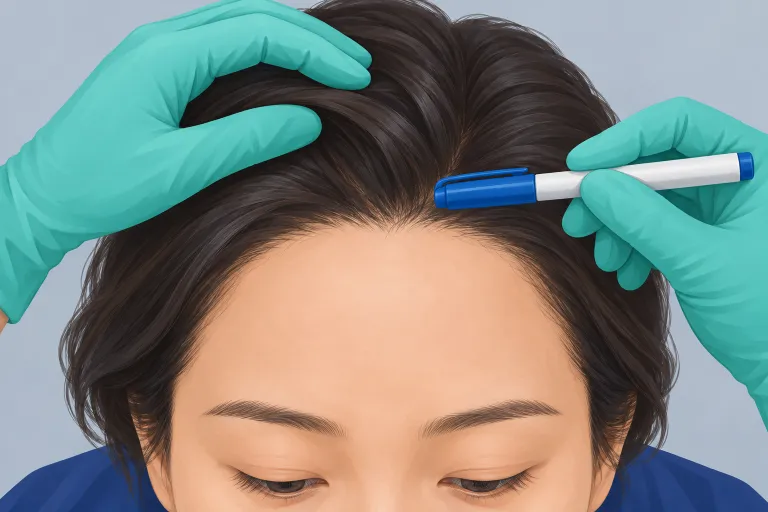
Ask what scar and hair-related risks apply to the proposed technique. What changes would warrant a review, and who would assess them after you return home?
The AAFPRS says numbness and itching may occur as incisions heal. Ask the surgeon how to distinguish expected changes from symptoms that need assessment, and when to discuss scar care.
Aftercare during brow lift recovery
Get one written set of instructions for your operation. These points from the medical sources can help you check what that plan needs to address:
- Head position: Cleveland Clinic advises elevation for at least 2 days. Ask how to follow that instruction while resting and sleeping.
- Dressings and closure: Cleveland Clinic describes padding and bandages, with stitches or staples. Ask who will handle each dressing change and whether your closure needs a removal appointment.
- Activity: the AAFPRS says strenuous activity may need to wait beyond the usual recovery period. Ask about the daily activities you plan to resume.
For washing, medicines or products near the incisions, ask the operating team for instructions specific to your operation. What should you use, what should you avoid, and when should you check back?
When to contact the surgical team
Ask for written warning signs before discharge. Which symptoms require immediate contact, which require an examination, and where should you go if the team can't be reached?
Get the daytime and after-hours contact details. Ask how the team handles a concern while you're in Thailand and after you're home, including who can arrange an in-person assessment.
Brow lift risks and factors that can affect recovery
Discuss the risks with the operating surgeon before deciding. Cleveland Clinic lists bleeding, infection and scarring, along with pain, intense scalp itching and numbness.
Cleveland Clinic's list also includes limited eyebrow movement, asymmetry (unevenness between the sides), hair-follicle loss around incisions and a reaction to anesthesia. Ask how these risks relate to the technique being proposed.
The AAFPRS additionally lists eye irritation or dryness, an elevated hairline, temporary or permanent nerve damage, and an unsatisfactory result. Ask what further care might involve if a complication occurs.
For suitability, the AAFPRS describes candidates in good overall health, without a complicating underlying condition, who don't smoke and have realistic expectations. Discuss your health history and smoking with the surgeon, and ask whether either changes the proposed recovery plan.
Why recovery and scars can differ by brow lift technique
The AAFPRS describes open or coronal surgery as an option for more significant sagging or wrinkles. Its temporal approach addresses the outer brow rather than the central brow.
In the AAFPRS description, a mid-forehead approach can suit people with pronounced forehead creases, a high hairline or baldness. A direct lift can be used for severe brow droop, marked asymmetry or an unsuccessful previous lift.
Ask why the surgeon proposes that incision and which part of your brow it would change. If additional surgery is proposed, ask for a recovery plan covering the whole operation.
Yanhee's Thai endoscopic forehead and brow-lift page describes, translated from Thai, "five incisions no longer than 2 centimetres".
Ask your surgeon for the planned incision count and placement. What recovery restrictions come with that specific operation?
Planning brow lift recovery in Thailand before flying home
Ask the hospital to write down your admission, local follow-up and proposed departure dates separately. Who will assess whether you can travel, and when will that assessment happen?
Yanhee's general international-patient page describes "the standard review seven days after surgery for stitch removal and assessment with your surgeon." This is its general surgical process; ask which appointments apply to your brow lift.
The same Yanhee page says discharge documents include a fit-to-fly certificate. Ask when your surgeon will assess your travel plan and what happens if another review is needed before departure.
For contact after returning home, Yanhee says, "you can send monthly photo updates to your doctor to track your healing". Ask how the team would arrange an examination if a concern needs one.
Before booking travel, get answers to these questions:
Results, alternatives and expectations after recovery
Cleveland Clinic says complete forehead healing may take up to 6 months. Ask when your surgeon plans to review healing and discuss the result.
The AAFPRS says a brow lift doesn't directly treat eyelids, facial volume loss, skin texture or discoloration, or bone shape. It also doesn't directly target dynamic wrinkles, meaning lines caused by repeated facial movement.
The AAFPRS lists fat grafting and fillers, laser resurfacing, chemical peels and microneedling among alternatives or additional treatments. Its options also include neurotoxin injections, such as Botox, and ultrasound or radiofrequency treatments.
Cleveland Clinic lists eyelid surgery, facelift, mini facelift, neck lift and skin resurfacing as procedures that may be combined with a brow lift. Ask what each suggested treatment would address and what aftercare it would add before agreeing to combined surgery.
Questions to get answered before you book
In this section: brow lift in Thailand, what a brow lift costs in Thailand and endoscopic brow lift.
Frequently asked questions
How long does brow lift recovery take?
Cleveland Clinic says most people can return to work or school within 10 to 14 days, with complete healing taking up to 6 months. The AAFPRS says recovery usually takes no more than 2 weeks and places final results at about 6 months.
When can I return to work or exercise after a brow lift?
Cleveland Clinic says most people can return to work or school within 10 to 14 days. It advises avoiding heavy lifting and strenuous activity for a few weeks; ask your surgeon for a schedule covering your actual duties and exercise.
Where are brow lift scars located?
The AAFPRS describes incisions near or behind the hairline, at the temples, in forehead creases or above the brows, depending on technique. Ask the surgeon to show you the proposed incision positions and discuss scar and hair-related risks.
What are the main brow lift risks?
Cleveland Clinic lists bleeding, infection, scarring, pain, numbness, asymmetry, limited brow movement, hair-follicle loss and anesthesia reactions. The AAFPRS also lists eye irritation or dryness and temporary or permanent nerve damage.
How long should I stay in Thailand after a brow lift?
Ask your surgeon for a stay plan covering the appointments you need before departure. Yanhee's general international-patient process describes a review seven days after surgery; confirm your own brow-lift appointments and travel assessment with the hospital.
Can I fly home after brow lift surgery?
Ask the operating surgeon when you can travel and how clearance will be assessed. Yanhee's general process includes a fit-to-fly certificate in discharge documents; ask what your hospital requires before issuing yours.
Ask the Hospital How Long to Stay Before You Fly Home
Tell us the procedure, your budget and your dates, and any hospitals you are considering.
Get My Free Quote →Free, no obligation. Nothing goes to a clinic without your OK.