Teardrop vs Round Implants: Shape, Rotation and Surface
Round implants are equally wide and tall, with more fullness at the top; teardrop implants, also called anatomical implants, have a teardrop shape. A 2019 review of five comparative studies found no overall appearance advantage for anatomical implants.
If you're considering breast augmentation in Thailand, ask the surgeon to explain the proposed shape and surface, meaning whether the implant's outer layer is smooth or textured, together.
Clinics cannot pay to be listed or ranked higher on AsiaPatient.
Round and anatomical implants: the practical difference
The 2021 guide published by BAAPS, ABS and BAPRAS, three UK surgical societies, uses anatomical and teardrop for the same shape category. It describes smooth implants as almost always round and anatomical implants as tending to have a textured surface.
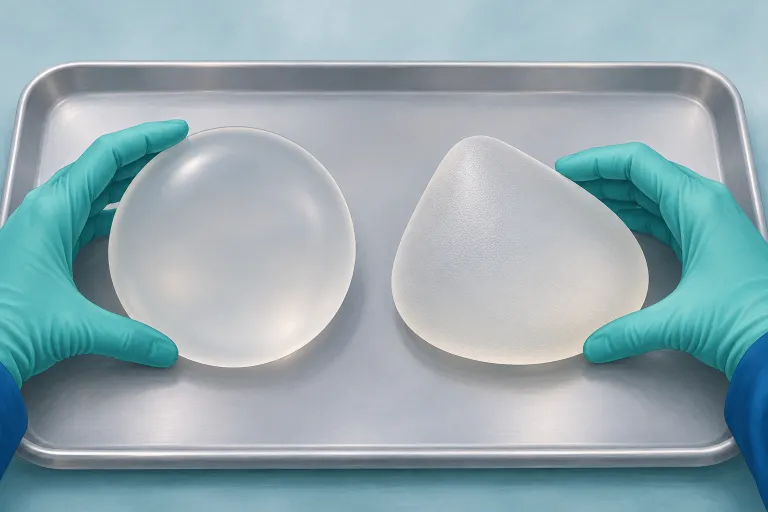
Ask to see the proposed implant's label and have the surgeon identify its shape and surface separately. Keep those details beside the brand and model when comparing written plans.
Comparison table: shape, surface, rotation and what studies report
| Comparison point | Round implants | Anatomical, or teardrop, implants | Source |
|---|---|---|---|
| Shape | Equal width and height; more top volume | Teardrop-shaped | Joint UK guide |
| Surface | Can be smooth or textured; smooth implants are almost always round | Tend to be textured | Joint UK guide; Pattaya hospital options |
| Rotation | Rotation isn't noticeable | Rotation can change the overall breast shape | Joint UK guide |
| Comparative appearance | Round comparison group in the five-study review | No overall appearance advantage found | Cheng and colleagues, 2019; study details below |
Why implant surface belongs in the shape conversation
The joint UK guide describes implant shells as usually silicone, with either a smooth or textured surface. It connects anatomical implants' tendency to be textured with the effect rotation can have on their shape.
Filling is another specification: the US Food and Drug Administration (FDA) describes saline implants as silicone shells containing sterile saltwater, and silicone gel implants as silicone shells containing gel. Ask the surgeon to write down the filler as well as the shape and surface.
What regulators say about textured implants
The FDA says BIA-ALCL risk is higher with textured than smooth implants. BIA-ALCL means breast implant-associated anaplastic large cell lymphoma, a cancer of the immune system usually found in scar tissue and fluid near an implant.
The FDA considers an individual's risk low, but describes the cancer as serious and potentially fatal, particularly without prompt treatment. Its patient information lists persistent swelling, a mass or pain near the implant as the main symptoms.
Separately, the FDA's postmarket safety page says Allergan recalled Natrelle BIOCELL textured implants and tissue expanders in July 2019. Smooth-surface implants weren't affected by that recall.
The FDA also publishes medical device reports about BIA-ALCL. It says under-reporting, duplicate reports and missing information about device use prevent the reporting system alone from determining how often an event occurs.
Ask for risk information that applies to the exact proposed model and surface. Don't use a count of reported cases as your personal risk estimate.
Do textured implants stop being an option?
In its 2021 patient information, the UK's Medicines and Healthcare products Regulatory Agency (MHRA) publishes advice from the Plastic, Reconstructive and Aesthetic Surgery Expert Advisory Group (PRASEAG). The group explains why it wasn't advising a ban limited to textured implants and says they are less likely to rotate or move.
That is a UK regulatory position. For a proposed operation in Thailand, ask the surgeon to identify the device's Thai authorization and explain why they propose that surface.
What a surgeon weighs
In a 2015 paper, Hedén and colleagues say shape choice should combine the patient's wishes, anatomy and surgical history. The recommendations are experience-based.
Rattinan Clinic's explanation of implant selection lists breast and chest width, skin elasticity and existing tissue as factors that help guide selection and placement. This is the clinic's stated approach to assessment.
Ask which measurements and parts of your surgical history affect the proposed choice. If the surgeon suggests a different shape from the one you expected, ask them to explain the reason and the trade-offs for you.
Can people tell round and teardrop implants apart?
The 2017 randomized comparison and 2019 review examined appearance and shape identification in different study settings.
If a consultation includes a claim that one shape will look better for you, ask which findings and examination details support that assessment.
The 2017 randomized comparison
In one 2017 randomized trial by Hidalgo and Weinstein, 75 patients undergoing primary augmentation had a round silicone implant placed on one side and an anatomical silicone implant of similar volume on the other for comparison. Reviewers assessed photographs taken during surgery, after which the anatomical device was replaced with a round implant.
The photographs were taken during surgery, and the comparison was made on those intraoperative photographs.
Plastic surgeons correctly identified the implant shape in 26.5% of cases. Neither the surgeons' preference nor the lay reviewers' preference for the anatomical versus round side was statistically significant in this trial.
Ask how the surgeon relates this study to the proposed operation and the appearance you want to discuss. Keep shape identification separate from a reviewer's preference when asking about the results.
The 2019 systematic review and meta-analysis
Cheng and colleagues' 2019 review combined five comparative studies: one randomized and four observational studies of primary cosmetic breast augmentation.
The review found no aesthetic superiority for anatomical implants in overall appearance, naturalness, projection (how far the breast projects forward), or the contours of the upper and lower breast. Its pooled rate of correct shape identification by plastic surgeons was 52%, with a 95% confidence interval of 46% to 58%.
A confidence interval describes uncertainty around the pooled estimate. Ask the surgeon how the reviewed patient groups and implant models relate to the devices being discussed with you.
Implant rotation: why it matters more with a teardrop shape
Rotation can change the overall shape with an anatomical implant, according to the joint UK guide. The same guide says rotation of a round implant isn't noticeable.
A shape change might happen. Ask the surgeon about the likelihood and consequences for the exact device proposed.
Ask how they would assess a change in shape after surgery. If rotation were confirmed, what would they recommend, where would that care happen, and what follow-up would be needed?
What Thai hospitals and clinics print about shapes and brands
Ask the clinic to confirm the exact model available for your proposed operation. These clinic listings give you published shape and brand wording to use in that conversation.
Published shape and brand examples
Ekachai Hospital's public surgery list prints Mentor round-gel options and "Tear drop gel CPG (Mentor)". Its augmentation rows list "GA" (general anesthesia) and "1" under admission nights, read 4 November 2026.
Yanhee Hospital's price list prints round Mentor and round Motiva options with "1 Night", read 4 November 2026. Ask Yanhee which shape and model it would propose for you.
Bangkok Hospital Pattaya's information page, dated 7 October 2026, lists Mentor round and teardrop shapes, plus smooth and textured surfaces.
Yoskarn Clinic names Motiva and Mentor; its Mentor section lists round and anatomical shapes with smooth or textured options. These are the clinic's published device descriptions, read 4 November 2026.
For brand, authorization and warranty questions, see implant brands in Thailand. Take the proposed model name to the consultation so the surgeon can address that device specifically.
Questions to take to a Thailand consultation
Ask for these details in the written plan:
- What shape, surface, filler, brand and model are you proposing?
- Which examination findings and parts of my surgical history support that choice?
- What would change in the plan if I chose the other shape?
- How do you assess rotation risk for this device, and what would you do if it rotated?
- Which follow-up appointments do I need, and who should I contact after returning home?
- Is the implant itself included in the quote, and what is excluded?
Bangkok Hospital Headquarters' package terms explicitly exclude implants. Ask for an itemized quote that identifies the device and hospital charges, then use the breast augmentation cost in Thailand guide for the price comparison.
In this section: breast augmentation in Thailand, breast augmentation in Bangkok, best clinics breast augmentation, what breast augmentation costs in Thailand, fat transfer breast augmentation, gummy bear implants breast augmentation, how long implants last breast augmentation, implant brands breast augmentation, is it safe breast augmentation, packages breast augmentation, breast augmentation recovery and scars breast augmentation.
Frequently asked questions
What is the difference between round and teardrop implants?
The joint UK guide calls teardrop implants anatomical. It describes round implants as equally wide and tall, with more top volume.
Can teardrop implants rotate?
Yes. The joint UK guide says rotation can change the overall augmented breast shape. Ask how the surgeon would assess and manage that possibility for the proposed model.
Can people tell round and anatomical implants apart?
In Hidalgo and Weinstein's 2017 comparison of 75 primary-augmentation patients, surgeons identified shape correctly in 26.5% of cases. Cheng's 2019 five-study review reported a pooled 52%; both figures describe their respective study assessments.
Are teardrop implants always textured?
The joint UK guide says they tend to be textured. Ask for the exact surface listed on the proposed device's label.
What is the safest breast implant shape?
Ask the surgeon to compare the risks of the specific devices being considered for you. The FDA's BIA-ALCL warning distinguishes textured from smooth surfaces, with higher risk for textured implants.
Are gummy-bear implants round or teardrop?
Ask for the product name and shape when someone uses that nickname. The FDA's labeling list describes Natrelle 410 as highly cohesive, anatomically shaped silicone-filled implants and separately lists Motiva SmoothSilk Round silicone gel-filled implants.
Use the model's actual label to confirm what is being proposed, including its surface. Ask the surgeon to explain any nickname used in your quote.
Read next
- Breast augmentation cost in ThailandPublished hospital prices with what each includes, agency add-ons and the full trip budget.
- Breast augmentation packages in ThailandWhat hospital and agency packages include line by line, what they leave out, and what an agency adds over booking direct.
- Fat Transfer Breast Augmentation Thailand: Costs (2026)Compare Thai clinics' printed breast fat-transfer prices, sessions and limits, with society guidance, two reviews and an implant price comparison.
- Breast Implant Brands in Thailand: Prices by Brand (2026)Which implant brands Thai hospitals and clinics print, Yanhee's prices by brand and size, which brands the FDA lists and what makers' warranty pages print.
Ask a Thai Surgeon Which Implant Shape They Would Choose and Why
Tell us the procedure, your budget and your dates, and any hospitals you are considering.
Get My Free Quote →Free, no obligation. Nothing goes to a clinic without your OK.