Is Thailand Safe for Breast Augmentation? What You Can Check, and What the Regulators Print (2026)
Whether breast augmentation in Thailand is safe for you isn't something a web page can settle. What you can do from home is check four things: the hospital's certificate on the HA register, the surgeon's licence and diploma on two lookups, what the regulators print about implant risks, and who pays if something goes wrong.
No Thai complication or death rate for breast augmentation surgery appears in the regulators' pages or the studies cited on this page, so every risk figure here comes from the US FDA, the NHS, the UK surgeons' bodies or a named study.
Our breast augmentation in Thailand guide covers prices, implants and the seven-step surgeon checklist; this page holds the safety checks.
Nobody at AsiaPatient has had this operation. We read the registers, the regulators' pages and the sellers' own terms. Clinics cannot pay to be listed or ranked higher on AsiaPatient.
The registers you can check from home
The Healthcare Accreditation Institute (HA) certifies Thai hospitals and publishes a certificate status search. A hospital's row carries a "Show all history" link to every certificate with its level, start date and expiry date, printed day/month/year.
The Thai version heads the search "ค้นหาสถานพยาบาลที่ผ่านการรับรอง", which translates as "Search for medical facilities that have passed accreditation." The date columns are วันรับรอง (date of accreditation) and วันหมดอายุ (expiry date).
The Society of Plastic and Reconstructive Surgeons of Thailand (ThPRS) runs a member search in English by name, hospital, clinic or location. The page says: "Only Full Members of ThPRS are listed in this search, and some people have elected not to make their profile available here." ThPRS says its members must hold the Thai Board diploma in plastic and reconstructive surgery, or be a qualified expert in that programme.
The Thai search is headed ค้นหาสมาชิก (search members) and its note says the database holds ThPRS members only. The English page tells you to contact the secretariat about a name that doesn't appear. So a missing name might mean the surgeon opted out.
The two Thai societies' joint doctor search filters by province and workplace and shows ผ่านการยืนยันแพทย์ (passed doctor verification) beside each surgeon. Its button "ตรวจสอบแพทย์จากฐานข้อมูลแพทยสภา", which translates as "Check doctors from the Medical Council database.", links to the Council's own lookup at checkmd.tmc.or.th.
The Medical Council said in March 2026 (Post Today, in Thai) that a name search under its menu ตรวจสอบรายชื่อแพทย์ (check doctor list) shows "1.การพักใช้ใบอนุญาตประกอบวิชาชีพเวชกรรม พร้อมระยะเวลาที่กำหนด", which translates as "1. Suspension of the medical practice licence, with the set period.", plus revocations, with no reasons given. The Council was still loading the records through that month, so a name that returns nothing isn't proof of a clean record.
A third accreditor, the American Accreditation Commission International (AACI), is a US body separate from JCI and HA. Its public list shows Teeraporn Hospital with initial certification FEB 2026 and Rattinan Medical Center with DEC 2021, and neither is on the HA register under those names.
Joint Commission International's own directory gives the complete list of current JCI-accredited organizations, searchable by country, so check a hospital's "JCI-accredited" line there.
Every row below was read 27 October 2026 on the register linked, except the Medical Council row, which rests on the Council's March 2026 statement.
| Register | What a row shows | Thai label and translation |
|---|---|---|
| HA certificate status | Hospitals only; certificate rows with level, start date and expiry date | ค้นหาสถานพยาบาลที่ผ่านการรับรอง = search for medical facilities that have passed accreditation |
| JCI directory | The complete list of current JCI-accredited organizations, by country | none |
| AACI list | Teeraporn Hospital (FEB 2026) and Rattinan Medical Center (DEC 2021), with program and status | none (English page) |
| Medical Council lookup | Per the Council, March 2026: suspensions with their period, revocations, no reasons | ตรวจสอบรายชื่อแพทย์ = check doctor list |
| ThPRS member search, English and Thai | Full Members who opted in; absence proves nothing | ค้นหาสมาชิก = search members |
| Joint societies' doctor search | Filters by province and workplace; a verification mark the page doesn't explain; a button to the Council lookup | ผ่านการยืนยันแพทย์ = passed doctor verification |
Run the surgeon's name through the Council lookup and the ThPRS search, and the hospital's name through the HA register, before you pay a deposit.
One hospital, three pages: the Yanhee example
On the HA register, Yanhee International Hospital's history ends at the row "Re-accreditation 2 r2 12/01/2016 11/01/2019", with nothing listed after it, while its About page lists "Thai Hospital Accreditation (HA)".
Its own JCI page prints "Accreditation Effective: 11 March 2023" with the end date 10 March 2026 in the text. The certificate image on the same page reads "Effective 13 March 2026 through 12 March 2029".
So the hospital's own page carries both periods. Accreditation claims for 15 Thai clinics, set against the HA register, are on our best clinics page.
For operations under general anaesthesia, ThPRS tells patients on its patient safety page: "ศัลยแพทย์ตกแต่งดำเนินการในโรงพยาบาลที่ได้รับการรับรองความปลอดภัยตามมาตรฐานสากลเท่านั้น", which translates as "Plastic surgeons should operate only in a hospital accredited for safety to international standard." The society gives that as advice; Thai law splits a clinic from a hospital only by whether patients stay overnight (Department of Health Service Support manual, in Thai).
The risks as the regulators print them
The FDA's risks page lists complications "that occur in at least 1 percent of breast implant patients at any time" with no rate against any of them.
The FDA's 2020 labeling guidance carries an example patient checklist with ceilings: capsular contracture "reported in up to 51.7% of patients", rupture or leaking "reported in up to 31.2% of patients" and reoperation "reported in up to 59.7% of patients".
The FDA's 2011 review of silicone gel implants names the populations: "between 20 to 40 percent of augmentation patients and 40 to 70 percent of reconstruction patients had reoperations during the first 8 to 10 years after they received their implants".
On BIA-ALCL, a lymphoma linked to implants, the FDA's report counts stood at "a total of 1,380 MDRs from the U.S. and outside of the U.S." and 64 deaths as of 30 June 2024. Those are report counts, not a rate.
Its Q&A page calls an individual's risk "considered to be low" and says it "is higher for textured surface implants versus smooth surface implants".
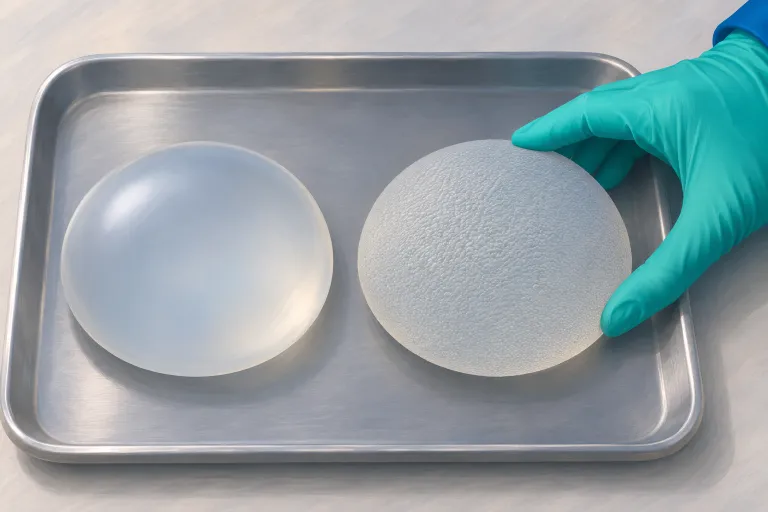
The UK surgeons' guide from ABS, BAAPS and BAPRAS (2021) prints figures: "Serious complications are uncommon with breast augmentation occurring in less than 1 in 100 operations." It puts capsular contracture at "up to 1 in 10 of all breast augmentations" and reoperation at "about 1%" a year, so that "after 10 years about 10% (10 women out of every 100) will have had to have more surgery."
| Source | Figure as printed | Population and window |
|---|---|---|
| FDA, risks and complications | complications in "at least 1 percent of breast implant patients"; no rate printed | No population or follow-up stated; page current as of 15 December 2023 |
| FDA 2020 guidance, example checklist | capsular contracture "up to 51.7%"; rupture or leaking "up to 31.2%"; reoperation "up to 59.7%"; removal "As many as 20 percent" within 8 to 10 years | Example checklist for manufacturers; issued 29 September 2020 |
| FDA 2011 update | reoperation "between 20 to 40 percent of augmentation patients"; removal "As many as one in five" | US post-approval studies, first 8 to 10 years |
| FDA, BIA-ALCL reports | 1,380 reports and 64 deaths | Reports to the FDA since 2011, as of 30 June 2024; not an incidence |
| NHS, breast enlargement | no percentages; infection "rare"; BIA-ALCL in "A very small number of people" | UK public page, last reviewed 21 September 2023 |
| ABS, BAAPS and BAPRAS guide | serious complications "less than 1 in 100 operations"; capsular contracture "up to 1 in 10"; reoperation "about 1%" a year and "about 10%" after 10 years; "1 in 10 implants had ruptured at 10 years" | Three UK bodies, 2021; the rupture line cites the US Core study |
| ASPS, risks and safety | no percentages; "The vast majority of people with breast implants experience no serious complications." | US society page, no review date shown |
What the studies say
Araco and colleagues (2007), one study, looked back at 3,002 women who had cosmetic augmentation with two surgeons at one Birmingham hospital from January 1996 to December 2001: "Hematomas were present in 46 patients (1.5%), infections in 33 patients (1.1%), breast asymmetries in 23 patients (0.8%), rippling in 21 patients (0.7%), and capsular contractures in 14 patients (0.5%)." Overall complications were 4.6% and reoperation 1.6%.
A single surgeon's review of 1,539 consecutive patients over 15 years, one study published in 2015, reports: "Total complication and reoperation rates were 6.8 and 7.7 percent, respectively." Average follow-up was 18 months, and the abstract doesn't name the country.
None of the three reviews names Thailand in its summary. A 2021 systematic review, one review, of cosmetic tourism for breast surgery pooled 171 patients from 24 studies, mostly "retrospective case series with no defined comparator", and in that group "common complications included: wound infection in 39% (n=67), breast abscess/ collection in 12% (n=21), wound dehiscence in 12% (n= 20) and ruptured implant in 8% (n=13)."
The percentages describe patients who came home needing treatment, and the abstract doesn't name a destination.
A 2018 review of 17 observational studies to April 2017, one review, says "Common destinations included Europe, South America and South East Asia." and its abstract gives no Thai figure.
A BMJ Open rapid review, one review published 13 January 2026, covered patients treated in NHS hospitals from 2006 to 2024 after elective surgery abroad: "The most common destination for surgery was Turkey (61%)." and "for cosmetic surgery tourism, infection and wound dehiscence were most commonly reported."
The only Thai breast-implant paper found was a 2020 case report of "the first known case of BIA-ALCL in Thailand, in which a 32-year-old woman developed BIA-ALCL 3 years after breast augmentation using textured implants." One case isn't a rate.
Going abroad: what home-country health bodies say
The NHS page on cosmetic surgery abroad says: "It can cost less than in the UK, but you need to weigh up potential savings against the potential risks. Safety standards may not be as high." It doesn't name a country.
BAAPS says "It is fairly common when you have work done overseas to have limited or no aftercare, particularly once you’re back in the UK."
The UK Foreign Office's Thailand health advice carries the one line about Thailand itself: "Private hospitals in Thailand are of a high standard but can be expensive. Public hospitals and clinics do not always meet UK standards, particularly outside Bangkok." It adds: "All hospitals require a guarantee of payment before treating patients."
The ASPS briefing paper on cosmetic surgery tourism says "Infections are the most common complication seen in patients who go abroad for cosmetic surgery."
The US CDC's Yellow Book chapter on medical tourism says "Complications, including infections and surgical revisions for unsatisfactory results, can compound initial costs."
When something goes wrong in Thailand
Prices in this section were read 27 October 2026 on the pages linked. Dollars at ฿33.14 = $1 (European Central Bank reference rates, 22 September 2026) are our arithmetic, not a quote.
Bangkok Hospital's package page says, grammar as printed: "This price excludes the treatments cost for any patient’s underlying or related conditions or complications relating surgery will incur an additional charge."
Yanhee's price list prints "Corrective surgery (case done elsewhere?) 2 Nights 181,000" THB ($5,462) and "Breast Implant Removal 1 Night 81,000" THB ($2,444). Those are prices, with no revision promise beside them.
Destination Beauty, a Bangkok agency selling packages mostly to Australian patients, sells Flyback Cover, "an optional protection plan" priced per procedure. The breast augmentation row reads "Breast Augmentation 8,950 $385 $430", so THB 8,950 ($270) with the agency's AUD and NZD approximations beside it.
The terms: "Valid for 12 months after the surgery date and must be purchased before surgery." and "For capsular contracture cases, the patient contribution is THB 65,000" ($1,961).
What it leaves out: "Flyback Cover is not valid for emergency medical treatment, infection treatment, implant size increases, or scar revision."
CosMediTour, an Australian agency, lists a "Surgery Travel Back Warranty" among its add-ons, with no terms printed. The complication and revision wording of the sellers we read is on our packages page.
Most of the accounts below are agency and marketplace reviews, and the agency disputes several. On Trustpilot, reviewers of Destination Beauty wrote:
- An Australian reviewer in August 2026, who had an operation in 2023 and a revision in 2024: an implant bottomed out, and her refund request was referred to the agency's legal team.
- A reviewer whose review was updated in July 2026: the implants weren't the ones she asked for and bottomed out, and her medical records weren't provided. The agency replied that it disputed the account.
- A reviewer in 2025 whose wife had a revision and lift: the right implant moved freely in the old pocket. The agency replied that the review wasn't from a real patient.
A Bookimed reviewer of B.Care Medical Center in Bangkok wrote in September 2023 that she got unclear answers about complications through an interpreter, and that the implant pocket tore and the implant dropped after surgery.
On the Thai Visa Advice board, a commenter whose friend blacked out at a clinic with no emergency equipment wrote: "clinics are not prepared for any type of emergency. ONLY GO to a hospital."
The Thai government's consumer route, per Pattaya Mail, is the Office of the Consumer Protection Board (OCPB) hotline 1166, its app and website, or a provincial Damrongdhama centre; the page doesn't say whether foreign patients can use these channels.
ThPRS puts the question to the surgeon before surgery, on its patient safety page: "หากทำศัลยกรรมไปแล้วไม่พอใจหรือมีปัญหาหลังการผ่าตัดต้องทำอย่างไร?", which translates as "If I have the surgery and am unhappy, or have a problem after the operation, what should be done?" A revision reserve sits in the full trip budget on our cost page.
Before you pay a deposit, get in writing who pays for a revision, for how long after surgery, and whether infection and the second trip are covered.
Insurance
Cover-More, selling in Australia, lists among its general exclusions: "claims arising from You having elective medical or dental treatment or surgery, a cosmetic procedure or body modification (e.g. tattoos and piercings) during the Journey, such as any complication".
1Cover, also Australian, says on its what's not covered page: "There is also no cover if you are planning to travel for cosmetic surgery or fertility treatment."
Staysure, a UK insurer, puts it in its policy wording help guide: "This means that if your trip is to travel abroad for ANY medical treatment including, but not limited to, dental treatment, cosmetic surgery or hair transplants then you would NOT be covered by our Insurance."
Those are three policies sold in Australia and the UK. Yours might read differently.
The checklist
Frequently asked questions
Is plastic surgery in Thailand safe?
No Thai complication rate for cosmetic surgery turned up in the regulators' pages or the medical literature, so there's no Thai number to answer with.
What you can check is the hospital on the HA register, the surgeon on the Medical Council lookup and the ThPRS member search, and the revision terms in writing. The UK surgeons' guide, which gives no Thai figure, puts serious complications from breast augmentation at "less than 1 in 100 operations".
Is Thailand good for plastic surgery?
By volume, the ISAPS survey estimated 127,300 surgical cosmetic procedures in Thailand in 2025, 10,640 of them breast augmentations, with 53.8 percent of procedures done in hospitals. Those are survey estimates. The UK Foreign Office says: "Private hospitals in Thailand are of a high standard but can be expensive. Public hospitals and clinics do not always meet UK standards, particularly outside Bangkok."
How do I check a Thai plastic surgeon's licence?
Run the full name through the Medical Council lookup (the societies' joint doctor search has a button to it), then through the ThPRS member search for the plastic surgery diploma. Since 3 July 2026 doctors promoting cosmetic services in Thailand must show their full name and licence number (Pattaya Mail).
What does a hospital's accreditation tell me, and what doesn't it?
An HA row shows the certificate a hospital holds, its level (a step, an accreditation or a re-accreditation) and its start and expiry dates; the register lists these as facilities that have passed accreditation. It doesn't tell you anything about the surgeon; that's the ThPRS search and the diploma.
Will my travel insurance cover complications from surgery in Thailand?
Cover-More, 1Cover and Staysure exclude cosmetic surgery trips in the wording above, and the NHS says travel insurance normally won't cover surgery that goes wrong. Read your own policy's exclusion list before you book.
What happens if I need a revision after I get home?
BAAPS says the NHS "will generally treat life-threatening complications" and the rest may fall to you. In Thailand, Bangkok Hospital bills complications as an additional charge, Yanhee prices corrective surgery at 181,000 THB, and Destination Beauty's Flyback Cover runs 12 months and excludes infection. Get the terms in writing before you pay.
Read next
- Breast Augmentation Thailand: Recovery and Flying (2026)Compare Thai clinics' printed recovery timelines and stay lengths, society guidance on flying, hotel nights, and patient accounts of follow-up at home.
- Breast augmentation scars: incision options and healingWhere each breast augmentation incision leaves its scar, how scars heal over the months, scar care, and what to ask a Thai surgeon.
- Breast augmentation cost in ThailandPublished hospital prices with what each includes, agency add-ons and the full trip budget.
- Breast augmentation packages in ThailandWhat hospital and agency packages include line by line, what they leave out, and what an agency adds over booking direct.
Get a Quote From a Hospital You Can Check on the Registers
Tell us the procedure, your budget and your dates, and any hospitals you are considering.
Get My Free Quote →Free, no obligation. Nothing goes to a clinic without your OK.