Skin Removal After Weight Loss: Procedures, Scars and Recovery in Thailand
Skin removal after weight loss covers more than one operation. The procedure depends on the area of loose skin, such as the abdomen, lower body, upper arms, inner thighs, breasts or back. See body lift in Thailand.
Cleveland Clinic describes procedures for different body areas, while its lower body lift guide explains surgery around the front and back of the lower torso.
Clinics cannot pay to be listed or ranked higher on AsiaPatient.
What excess skin removal surgery means after major weight loss
Cleveland Clinic uses excess skin removal as a term for several plastic surgery procedures after major weight loss.
The American Society of Plastic Surgeons (ASPS) says a body lift removes excess sagging skin and fat. It says body lifts aren't intended strictly for removing excess fat.
Ask the surgeon to identify which areas a proposed operation would address. Also ask which areas would remain outside that operation and what changes you could reasonably expect.
Which operation sources describe for each area of loose skin
Use these names when describing your concerns at a consultation.
| Body area | Procedure term | What the source describes |
|---|---|---|
| Abdomen | Tummy tuck, or abdominoplasty | The UK National Health Service (NHS) says this can involve removing excess loose skin, fat and stretch marks, and tightening abdominal muscles. |
| Abdomen, waist, hips, buttocks and outer thighs | Lower body lift, also called belt lipectomy | ASPS lists these areas for a complete lower body lift. See lower body lift in Thailand. |
| Upper arms | Arm lift, or brachioplasty | Cleveland Clinic describes removing skin hanging from the upper arm. See arm lift in Thailand. |
| Inner thighs | Thigh lift, or thighplasty | ASPS describes inner-thigh reshaping through groin incisions that can extend toward the knee. See thigh lift in Thailand. |
| Breasts | Breast lift | ASPS lists breast lift, to correct sagging, flattened breasts, among the procedures that may be recommended after major weight loss. Ask what a proposed breast operation would address and which scars it would leave. |
| Back of the lower torso | Lower body lift | Cleveland Clinic describes a wrap-around incision treating the back as well as the front. Ask the surgeon to mark the intended extent on your own plan. |
For breast concerns, ask separately about the proposed operation's recovery and risks. For skin higher on the back, ask which procedure, if any, the surgeon proposes for that specific area.
Stable weight and an assessment before planning
Cleveland Clinic's excess skin removal guidance includes maintaining goal weight for at least six months after major weight loss among its suitability factors. It also lists not smoking, generally good health and realistic expectations.
In a 2010 article on body contouring after massive weight loss, Boswell says patients should have reached and maintained a weight-loss plateau before starting body contouring. The article describes that plateau as taking 12 to 24 months after bariatric surgery, meaning weight-loss surgery.
Maintaining goal weight and reaching a weight-loss plateau are different parts of planning. Ask the treating surgeon how your weight history affects assessment and what they need to review before planning an operation.
When operations are performed in stages
ASPS says body contouring is often performed in stages. The person's condition and goals, together with the surgeon's judgment, influence the plan.
A plan might involve stages.
Boswell describes grouping operations by body region or priority. Ask whether the proposed plan involves one operation, several procedures together, or separate operations with recovery between them.
Scars are part of the trade-off
Cleveland Clinic's arm-lift guidance says scars may fade but won't disappear completely. Its lower-body-lift guidance also describes lasting scars.
Ask the surgeon to draw the planned incision before you agree to surgery. Discuss its length and position, including where it would extend beyond the area that concerns you most.
Abdomen and lower-body scars
Cleveland Clinic distinguishes a tummy tuck focused on the front of the abdomen from a belt lipectomy with a wrap-around, 360-degree incision. The latter also treats the buttocks at the back.
Ask whether the proposed abdominal operation stops at the front or extends around the torso. Have the surgeon explain the scar pattern for the exact operation they propose.
Arm and thigh scars
Yanhee Hospital describes mini, standard and extended arm lifts. Its mini scar sits in the armpit crease; the standard scar follows the inner arm toward the elbow; the extended version continues onto the side of the chest.
Yanhee states: "The scar from a full arm lift runs from armpit to elbow and is permanent." Ask which of the hospital's arm-lift patterns is being proposed and why.
For the thigh, Yanhee describes a groin-crease lift for upper inner-thigh laxity, meaning loose skin. For greater excess after major weight loss, it describes a vertical medial thighplasty, meaning an inner-thigh lift with a vertical incision.
Its description of that incision is: "The incision runs from the groin down the inner thigh, sometimes as far as the knee."
Recovery and aftercare
Recovery differs by operation. Ask the treating team for your own instructions on work, movement and follow-up.
| Source and operation | Published recovery information |
|---|---|
| Cleveland Clinic: lower body lift | Describes drains, bandage changes and snug garments that may minimize swelling. It advises avoiding exercise and heavy lifting for approximately six weeks. |
| Rattinan Clinic: belt lipectomy | Describes return to light daily activities in two to four weeks, depending on healing and surgeon guidance. It says strenuous exercise, heavy lifting and excessive bending should be avoided until cleared. |
| Yanhee: arm lift | Prints two to three weeks for arms to look and feel near normal, and six to 12 months for scar maturation. |
| Yanhee: thigh lift | Prints about three weeks for thighs to look close to normal, and six to 12 months for scar maturation. |
| Yanhee: tummy tuck | Prints a compression garment for four to six weeks, normal activity from about two weeks, and follow-up with stitch removal at seven to 10 days. |
For arm lift specifically, Cleveland Clinic describes wearing compression for several weeks. It says bruising and swelling may settle in a few weeks.
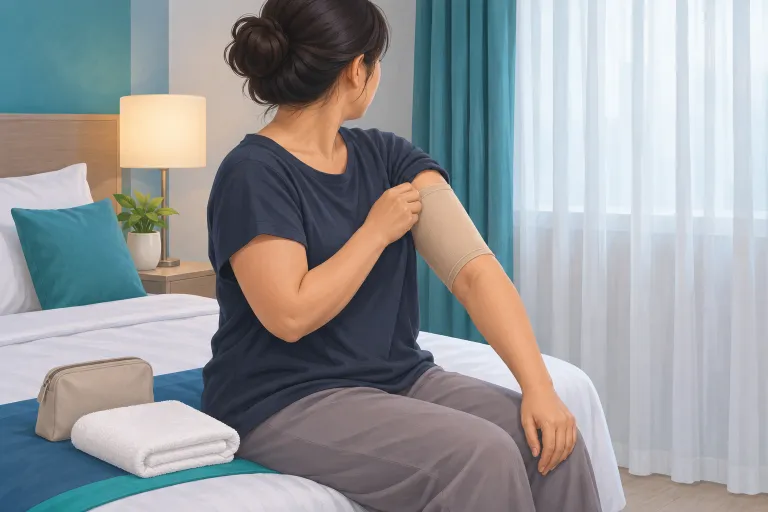
Ask how the garment and wound-care instructions would affect your daily activities.
What Thai hospitals and clinics print about assessment and aftercare
Yanhee's arm-lift page lists preoperative tests and postoperative care in its package, alongside a two-night hospital stay. Its thigh-lift page also lists two hospital nights.
The arm page places follow-up and a stitch check seven to 10 days after surgery. The thigh page gives the same interval, and both describe it as setting the minimum time to allow in Bangkok.
Rattinan's belt-lipectomy page gives two hospital-stay statements: its package lists four days and three nights at Vimut Hospital, while its recovery text says patients usually stay two to three nights. The latter describes "close monitoring, comfort, and wound care."
Ask Rattinan which stay applies to the proposed booking. Ask any treating team which assessments happen before surgery and who handles wound care after discharge.
Risks and limits to discuss with the treating team
ASPS's body-lift risk list includes anesthesia risks, bleeding, infection, fluid collection and poor wound healing. It also lists numbness, unfavorable scarring, asymmetry, recurrent loose skin and possible revision surgery, meaning another operation.
Cleveland Clinic lists wound separation and delayed healing among lower-body-lift risks. It also names deep vein thrombosis, a blood clot in a deep vein, and pulmonary embolism, a clot in the lungs.
Ask the surgeon which risks apply to each proposed operation and how the team would respond. Request a contact for concerns after discharge, including outside normal appointment hours.
What two published studies report on complications
One 2016 study by Poodt and colleagues from a hospital in the Netherlands retrospectively analyzed 100 lower-body-lift patients. It reported an overall complication rate of 78%, with 22% having major complications and 56% having minor complications.
One 2022 study by Ibrahiem from Egypt was a retrospective case-control study of 653 massive-weight-loss patients, covering 1,254 body-contouring procedures. It reported 105 cases with complications, or 16.07% overall, including major and minor complications.
Poodt studied lower body lift; Ibrahiem studied multiple body-contouring procedures.
Keep those findings separate when discussing them with a surgeon. Ask how closely each study's patients and operations resemble your proposed plan, and which risks the surgeon expects to matter in your case.
What this means for someone flying to Thailand
Ask for separate dates for hospital discharge, local follow-up and travel clearance. A hospital admission count and an appointment schedule answer different questions.
The Government of Canada warns that flying soon after surgery may increase risks, including blood clots. It advises discussing air travel with a clinician, checking airline rules and planning aftercare at home.
The US Centers for Disease Control and Prevention (CDC) advises arranging follow-up care before travel and obtaining medical records before returning home. Ask who will receive those records and take over care after you leave Thailand.
Questions to get answered in writing
- Which operation is proposed for each area, and what would it leave untreated?
- Where would each incision run, and could its length change after examination?
- Is the plan combined or staged, and what would determine timing between operations?
- What weight history, medical information and preoperative tests does the team need?
- At which hospital would surgery take place, and what hospital stay is planned?
- What is the plan for drains, dressings and compression garments?
- When are the wound reviews and any stitch removal, and who performs them?
- Who decides fitness to fly, and which reviews need to happen before departure?
- Who handles concerns after discharge and after return home, and how can they be reached?
In this section: body lift in Thailand, arm lift body lift, what a body lift costs in Thailand, lower body lift and thigh lift body lift.
Frequently asked questions
How can I tighten loose skin after weight loss?
Chelsea and Westminster Hospital says exercise can't completely eliminate loose skin. Ask a surgeon whether the area you want assessed involves excess skin, fat or both, and what the proposed options could address.
What surgery removes loose abdominal skin after weight loss?
The NHS says a tummy tuck can remove excess loose skin from the abdomen. ASPS describes a lower body lift covering the abdomen, waist, hips, buttocks and outer thighs.
Ask which operation matches the areas marked in your consultation plan.
What is the difference between an arm lift and a thigh lift?
Cleveland Clinic describes arm lift for the upper arms and thigh lift for the inner thighs. ASPS describes arm incisions along the inside or back of the upper arm, and inner-thigh incisions from the groin that can extend toward the knee.
Can several skin-removal operations be done together?
Ibrahiem's study examined body-contouring procedures performed together, while ASPS says body contouring is often staged. Ask the surgeon to explain the proposed combination or separate stages, including the reasons for that plan.
How long do scars take to settle after arm or thigh lift surgery?
Yanhee prints six to 12 months for scar maturation on its arm-lift and thigh-lift pages. Ask what scar changes to expect and when the surgeon would review concerns about healing.
Read next
- Fleur-de-Lis Tummy Tuck: Who It May Suit, Scars, RecoveryWhat makes a fleur-de-lis tummy tuck different, who it may suit after major weight loss, the vertical scar tradeoff and what recovery involves.
- Lower body lift vs tummy tuck: which fits your loose skin?How a lower body lift and a tummy tuck differ in scope, scars and recovery planning, and what to ask a surgeon about front-only or all-round loose skin.
- Lower body lift scars: where they run and how they healWhere a lower body lift scar runs, why it is permanent, how clothing placement is planned and what to settle with a surgeon.
Ask Which Skin-Removal Procedure Addresses Each Area
Tell us the procedure, your budget and your dates, and any hospitals you are considering.
Get My Free Quote →Free, no obligation. Nothing goes to a clinic without your OK.