Incisionless Otoplasty in Thailand: Stitch Ear Pinning and Earfold (2026)
Incisionless otoplasty uses a needle to make ear cartilage more flexible, then stitches to hold the ear in its new shape, according to the UK National Health Service (NHS). If you're considering otoplasty in Thailand, ask the surgeon to confirm the exact technique before arranging treatment.
AsiaPatient isn't a hospital, clinic or agency and doesn't recommend a procedure for an individual.
Clinics cannot pay to be listed or ranked higher on AsiaPatient.
What incisionless otoplasty is
The NHS description doesn't involve a skin incision. After the needle work, stitches hold the shape or attach cartilage to bone behind the ear; general or local anesthesia may be used.
For a consultation about incisionless ear pinning, ask where the needle and stitches will enter. Ask which anesthesia is proposed and what aftercare applies to that operation.
Incisionless, stitch and standard otoplasty techniques
Incisionless or stitch technique
The American Society of Plastic Surgeons (ASPS) describes incisions generally behind the ear, together with internal, nonremovable stitches that secure the reshaped cartilage.
The American Academy of Facial Plastic and Reconstructive Surgery (AAFPRS) also describes using stitches to hold the cartilage in place without removing any cartilage, after an incision behind the ear. Keeping cartilage and avoiding a skin incision are separate details to ask about.
If a surgeon uses the label "cartilage-sparing," ask whether the plan includes a skin incision. Ask whether any cartilage will be cut or removed, and which stitches will remain after healing.
Standard otoplasty with an incision behind the ear
Cleveland Clinic describes a cut behind the ear or within its folds, adding or removing tissue, reshaping the ear, and closing with stitches. The steps vary with the type of otoplasty.
ASPS describes techniques that create or increase the antihelical fold, the fold just inside the ear's rim. It also describes reducing conchal cartilage, in the deeper bowl of the outer ear.
Ask the surgeon to point out which part of your ear they propose changing. Request an explanation of why they suggest that approach and what alternatives they would discuss for the same change.
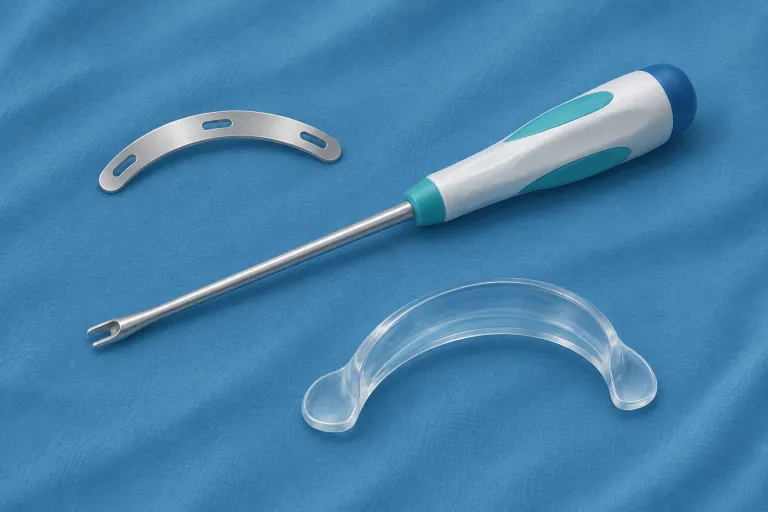
Earfold is an implant method, not another name for stitch otoplasty
Kang and colleagues describe Earfold as a system containing an implant, an introducer and a Prefold positioner. Their 2018 interim safety series covered 403 patients treated with 1,200 implants; the abstract doesn't specify the treatment country.
If Earfold is mentioned in a consultation, ask whether that exact implant is offered and who would perform the operation. Ask the surgeon to explain the introducer and positioner, how the implant is placed, and the follow-up arrangements.
What the evidence can and can't say about outcomes
The studies below examine different surgical techniques and groups of patients.
| Source | Design, population and country | Technique or comparison | Follow-up | Reported finding |
|---|---|---|---|---|
| Haytoglu and colleagues, 2015 | One prospective comparison, 60 patients; country not specified in the abstract | Two incisionless suture techniques | Six months | No statistically significant difference in patient satisfaction between the groups |
| Kaleeny and colleagues, 2026 | One practical review with meta-analysis, combining 18 studies, 1,590 patients and 3,060 ears; countries not specified in the abstract | Otoplasty techniques across the included studies | Mean 24.5 months | Pooled recurrence 2.8% and revision 2.1% |
| Thomson and colleagues, 2026 | One systematic review of 22 studies, including 19 retrospective and three prospective cohorts; combined patient count and countries not specified in the abstract | Suture, cartilage-scoring, incisionless and combined methods | Not stated in the abstract | Some combined methods may be associated with lower recurrence and reoperation; the authors call for higher-quality evidence |
| Alanazi, 2024 | One systematic review and meta-analysis of 14 studies; combined patient count and countries not specified in the abstract | Cartilage-sparing otoplasty, including comparisons with cartilage scoring | Not stated in the abstract | Recurrence or reoperation 4.27%, with a 95% confidence interval of 2.93% to 6.22%; the abstract reports significant heterogeneity for some outcomes |
| Kang and colleagues, 2018 | One interim safety series, 403 Earfold patients; country not specified in the abstract | Earfold implants | Interim report; follow-up ongoing | Intervention was needed for adverse events in 39 of 403 patients, or 9.7% |
Thomson's review says combining sutures with cartilage scoring, or cartilage scoring with a flap, may be associated with lower recurrence and reoperation. Ask the surgeon to explain what cartilage scoring or a flap would involve in your operation.
Alanazi's review found no statistically significant difference between cartilage sparing and cartilage scoring for recurrence or reoperation, hematoma or hemorrhage, or wound infection.
Ask which published technique most closely matches the surgeon's plan. Ask how long their own patients are followed and how they record a return of ear prominence or another operation.
Who may be considered for an incisionless technique
In the 2015 study of 60 patients, Haytoglu and colleagues describe the two incisionless techniques as options especially for children with soft ear cartilage and an isolated underdeveloped antihelical ridge.
Ask whether the shape you want to change involves the antihelical ridge, another part of the ear, or both. Ask how cartilage firmness affects the surgeon's proposed method.
For general ear pinning, the NHS says surgery is unsuitable below age 5 because ears are developing and the cartilage is too soft to hold stitches. BAAPS, the British Association of Aesthetic Plastic Surgeons, recommends waiting until a child is at least 5 and wants the correction.
For an adult consultation, ask what evidence and experience support the proposed incisionless method for your ears.
Recovery and aftercare after ear pinning
ASPS says you will be given specific instructions that may include how to care for your ears and when to follow up. Ask for instructions that identify your technique, including which dressings and stitches need removal.
If you have a head bandage, the NHS says to keep it clean and dry, and that you will not be able to wash your hair until it has been removed. You might need a headband at night for several weeks.
| Period | NHS general ear-surgery guidance | Question for your surgeon |
|---|---|---|
| After 5 to 10 days | Bandage, if used, and stitches removed, unless stitches dissolve | Which appointment covers removal? |
| After 1 to 2 weeks | Most children can return to school | What activity restrictions continue? |
| After 4 to 6 weeks | Swimming should be OK | When can I swim after my operation? |
| Around 8 weeks | Contact sports should be OK | When can I return to my specific sport? |
Cleveland Clinic advises avoiding ear pressure, sleeping on your back and choosing clothing that doesn't pull over the head. It says the first follow-up will likely be about one week after surgery, with one or two further visits over the following weeks.
Healing times may vary. Cleveland Clinic says recovery can take up to eight weeks.
The otoplasty recovery in Thailand guide covers aftercare in more detail. Take your surgeon's written schedule into the discussion, including the date of any appointment planned after you leave Thailand.
Risks and reasons to discuss the technique in detail
The NHS lists occasional cartilage inflammation, a blood clot in ear skin, stiffness, asymmetry and renewed prominence. It describes a small operative risk of excessive bleeding, incision infection and an allergic reaction to anesthesia.
Cleveland Clinic lists hematoma, meaning bleeding around ear cartilage, infected cartilage, asymmetry, usually temporary numbness and scarring. Ask which risks apply to the proposed operation and how the surgeon would treat them.
The NHS says the stitches may come to the surface of the skin. In Haytoglu's 2015 study of 60 patients, suture extrusion was detected in 14.03% of one group and 16.1% of the other.
Kaleeny's 2026 review reported suture extrusion at 5.4% across its 18 included studies. Its population was 1,590 patients and 3,060 ears, with countries unspecified in the abstract.
In Kang's 2018 Earfold series of 403 patients, events needing intervention included implant revision, skin erosion over the implant and infection. The country is unspecified in the abstract, and only 36% returned for follow-up.
Ask how the surgeon handles a visible or exposed stitch, an implant concern, or a return of prominence. Include who would examine you if a concern develops after you've gone home.
What this means for a patient flying to Thailand
Ask the Thai surgeon whether the proposed operation is incisionless, uses an incision with stitches, or involves an implant. Request the technique name and the planned steps in writing before choosing travel dates.
Kamol Hospital's otoplasty page describes an incision behind the ear. Its aftercare section states: "Stitches are usually removed or dissolve in about a week."
Kamol's travel recovery page lists otoplasty within a facial-surgery group. Under "Total Length of Stay," it gives a minimum of 10 to 14 days for that group, with stitch removal sometime 5 to 10 days after surgery and surgeon follow-up sometime 10 to 14 days afterward.
The procedure page's approximate week and the group itinerary's 5 to 10 days are both Kamol's published wording. Ask which schedule applies to your operation and which stitches each instruction concerns.
That facial-surgery itinerary is a group schedule. Ask the hospital to confirm your own admission, local accommodation and appointment dates separately, along with the surgeon's advice about your flight home.
Questions to put in the same written request:
- Does the proposed operation involve any skin incision or cartilage removal?
- Which anesthesia is planned, and is a hospital night proposed?
- When will dressings and any removable stitches come off?
- What are the instructions for sleeping, hair washing and exercise?
- Which follow-up visits happen before departure, and what happens afterward?
- When does the surgeon advise flying for my itinerary, and what could change that advice?
- Who can assess an unexpected symptom after I return home?
In this section: ear surgery (otoplasty) in Thailand, otoplasty in Bangkok, what otoplasty costs in Thailand and otoplasty recovery.
Frequently asked questions
What is incisionless otoplasty?
The NHS describes a needle-and-stitch technique that makes no cuts in the skin.
Is incisionless ear pinning the same as stitch otoplasty?
Ask what "stitch otoplasty" means in the surgeon's plan. The AAFPRS describes using stitches to hold cartilage in place without removing any, after a behind-the-ear incision, so stitches can also be part of an open approach.
Is Earfold the same as incisionless otoplasty?
Earfold uses an implant system described in Kang's 2018 safety series, involving 403 patients, with the country unspecified in the abstract. Ask the surgeon to identify the exact device and explain its placement and aftercare.
Who may be suitable for an incisionless technique?
Haytoglu's 2015 study covered 60 patients and highlighted children with an isolated underdeveloped antihelical ridge and soft cartilage. Ask the surgeon how closely your ear anatomy matches the patients treated with the proposed technique.
How long does recovery take after incisionless otoplasty?
Cleveland Clinic says general otoplasty recovery can take up to eight weeks and varies between people. Ask your surgeon for an incisionless-specific plan, including return to work and exercise.
Can I have incisionless otoplasty in Thailand and fly home soon after?
Ask the operating hospital to confirm that it offers the exact technique and request the surgeon's flight advice for your case. Keep that answer separate from hospital discharge and any accommodation included in the booking.
Read next
- Otoplasty cost: Thailand beside the US, UK and AustraliaWhat Thai hospitals print for ear surgery (otoplasty), what US, UK and Australian sources give, and what each price covers.
- Ear surgery (otoplasty) in BangkokBangkok hospitals and clinics that print an ear surgery price, with what each includes.
- Otoplasty recovery: bandage, headband and the trip homeAfter ear pinning surgery: the bandage, the headband at night, swelling, return to school or work, risks, and what Thai hospitals print about stay.
Ask the Surgeon Which Ear Technique Fits Your Ears
Tell us the procedure, your budget and your dates, and any hospitals you are considering.
Get My Free Quote →Free, no obligation. Nothing goes to a clinic without your OK.